
Corporate | Global
We are Shaping the Future!Showcasing Success Stories as We Innovate for a Sustainable Tomorrow




—The essence of product security response to "protect the supply chain," as revealed through a joint validation exercise with Tokyo Electron
In the manufacturing industry, DX is progressing by utilizing data obtained from equipment, devices, and on-site systems. On the other hand, the need to strengthen product security is increasing due to the increasing sophistication of cyberattacks targeting products and systems, as well as the growing risk of impact spreading across the entire supply chain as equipment and systems become networked.
Furthermore, efforts to strengthen product security are accelerating, as the obligation to report system vulnerabilities and significant security incidents under the Cyber Resilience Act (hereinafter CRA*1), which targets products containing digital elements in Europe, will sequentially begin from September 2026.
Against this background, OMRON Corporation conducted a joint validation exercise with Tokyo Electron Ltd., a leading semiconductor manufacturing equipment manufacturer, assuming an actual cybersecurity incident affecting products and services.
In this article, we will introduce the importance of "building mutual understanding between companies before an incident," which became apparent through the joint verification conducted by both companies.
*1 CRA (Cyber Resilience Act)
European regulations, such as the Cyber Resilience Act (CRA), require security measures and the reporting of vulnerabilities and incidents for products containing digital elements. The reporting obligation will be implemented sequentially starting in September 2026, making compliance an urgent matter for manufacturers operating globally.
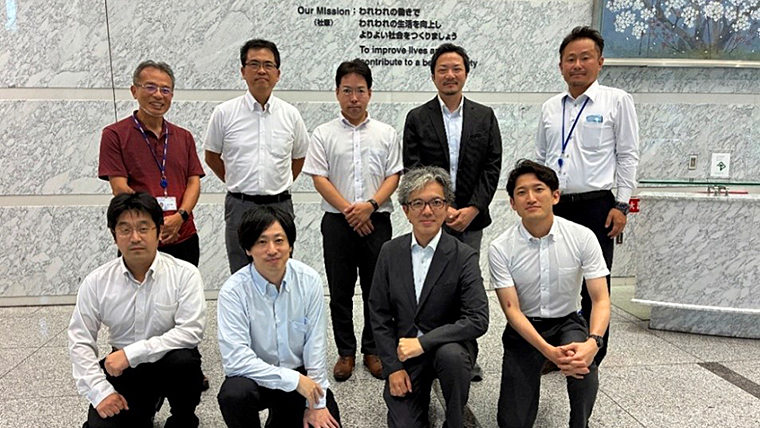 OMRON and Tokyo Electron, joint verification members for product security incidents (at OMRON Corporation in Kyoto)
OMRON has continuously worked on product security, such as operating the PSIRT*2, a specialized organization for product security, obtaining certification for international security standards, and being a CNA*3-certified organization with the authority to issue vulnerability information. However, for products like OMRON's, which are incorporated into equipment and systems and then delivered to end users, information sharing among the companies using them is essential. OMRON has long recognized the challenge that "product security cannot be completed by a single company alone."
On the other hand, there were barriers to overcome, such as differences in each company's unique operational know-how and decision-making criteria, in order to share information. Amidst these challenges, a turning point arrived in 2025, as the importance of product security increased. Tokyo Electron, which had already been deepening its understanding of each other's activities and challenges through technical exchanges regarding product security, also recognized the need for inter-company cooperation to ensure a swift response in times of emergency, in anticipation of CRA compliance.
Thus, based on the common understanding between the two companies that "product security is an issue that must be addressed across the entire supply chain," they began joint verification assuming security incidents that also take into account the impact on the entire supply chain.
*2 PSIRT (Product Security Incident Response Team)
A specialized organization responsible for improving the security of products and services developed and sold by the company, as well as handling vulnerability information and incident responses.
*3 CNA (CVE Numbering Authority)
An international certification body that can assign and manage the globally recognized vulnerability identifier (CVE ID) in-house. OMRON has obtained CNA certification.
The two companies immediately began deliberations in March 2025. In January 2026, they conducted a tabletop exercise assuming an incident occurred. However, when they actually re-experienced the scenario, more points of contention emerged than expected.
For example, when a report of a malfunction is received for a certain control device, it is not easy to determine whether it is a simple malfunction or a problem caused by a cyberattack. OMRON, as the supplier, needs to conduct an investigation. Meanwhile, Tokyo Electron must confirm the impact on the equipment. During this time, inquiries such as "Can the equipment continue to be used?" and "Is there any impact on production?" may be received from the end-user's customers.
At that time, it became clear how difficult it was to make decisions and coordinate during the initial stages when information was not yet fully available, such as who should grasp what information and at what stage they should explain it to the customer.
While assuming various incidents, they repeatedly verified the points of information sharing in the initial stages, the response and division of duties of each company, and the decision-making process, thereby forming a common understanding between the two companies.
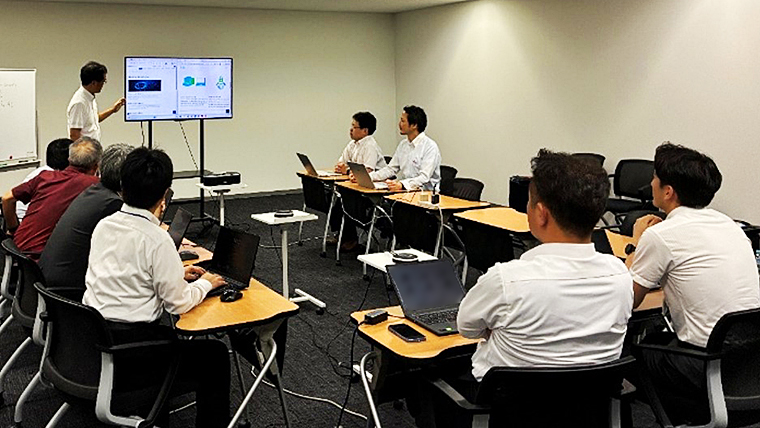 Based on the issues identified in the incident exercise, the two companies held discussions with an eye toward practical implementation.
The goal for both companies was not to increase new rules or organizational structures. Instead, they aimed to build an operational system that actually works by avoiding burdens on the field and utilizing existing non-conformity response processes and organizational structures.
In the verification process, while organizing the stakeholders such as end users, distributors, equipment manufacturers, and suppliers, the main focus was on clarifying "who decides what and by when," with the biggest point of contention being the "balance between accuracy and speed."
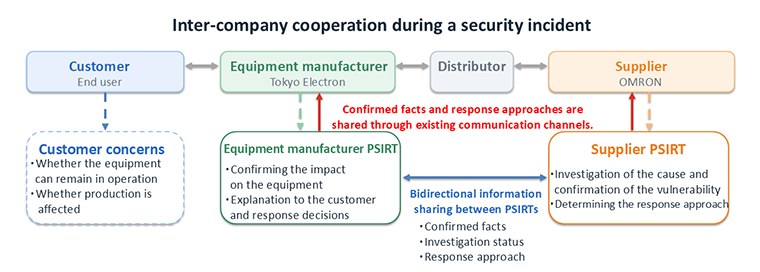 The quality and speed of inter-company collaboration enable timely and appropriate responses to customers while minimizing the impact on production.
The person in charge at Tokyo Electron reflects on that time as follows.
“Understanding the regulations and being able to actually collaborate were two completely different challenges. I felt strongly that, especially in an emergency, it is crucial to understand the other company's organizational structure and decision-making criteria.”
Through this joint validation exercise with an eye toward practical implementation, the two companies were able to gain three lessons.
1. Emergencies begin in a state of "not knowing what happened."
Response does not necessarily begin only after all facts have become clear. Rather than waiting for a perfect report, what is required is preparedness to make quick decisions under uncertain circumstances, while distinguishing between "confirmed facts" and "speculations/under investigation."
2. Communication channels alone are not enough for collaboration to work.
Simply setting up contact information and reporting routes is not enough. Unless criteria such as "what to share as facts" and "who is responsible for explaining to the customer" are established, even if contact is made, the response will not move forward.
3. What supports collaboration during emergencies is mutual understanding before an incident occurs.
It is people and organizations that drive regulations and rules. Understanding not only the other company's structure but also their "most critical business risks" during normal times leads to a rapid response in an emergency.
Under the "Medium-Term Roadmap SF 2nd Stage", OMRON is working to transform into a "GEMBA DX" company that solves customer problems and creates new value by combining data obtained from devices such as equipment and systems with on-site expertise to convert them into valuable information.
However, this value creation is not something that can be completed by OMRON alone. Data utilization in manufacturing sites involves various companies, such as customers, equipment manufacturers, and component manufacturers, collaborating to create value. Therefore, as data utilization advances and the connection points between companies increase, security risks may also expand beyond the scope of a single company. Strengthening product security across the entire supply chain and ensuring safety and security is an important prerequisite for delivering the value of data utilization to customers.
Mr. Ninomiya from the Safety and Environmental Department of Global Quality Center, Quality Environment Management Center, Industrial Automation Company, OMRON Corporation says the following.
“In this joint verification, we identified practical issues that were not apparent when only considering regulatory compliance. Product security can be made more effective through collaboration that transcends corporate boundaries. We will continue to deepen our collaboration with customers and partner companies to contribute to the provision of safe and secure products and services at manufacturing sites.”
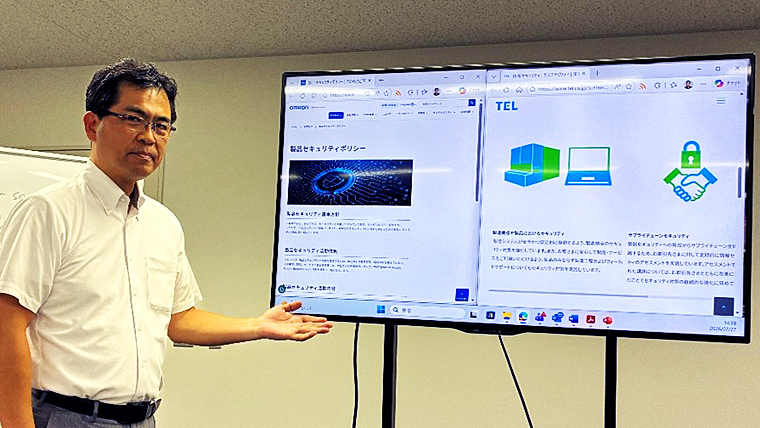 Mr. Ninomiya states that inter-company collaboration during normal times is crucial for product security measures that function in an emergency.
Regulations and rules alone will not make collaboration work in an emergency. It is essential to understand the other company's way of thinking and build a relationship of trust during normal times. This accumulation of trust forms the foundation of inter-company collaboration that supports safety and security at manufacturing sites and the creation of new value through "GEMBA DX."
The challenge of enhancing product security across the entire supply chain has only just begun. Both companies will continue to deepen their mutual understanding during normal times and advance collaboration to support safe and secure manufacturing.


