
Corporate | Global
We are Shaping the Future!Showcasing Success Stories as We Innovate for a Sustainable Tomorrow





Italians love their pasta and so do millions of people around the world. In Italian culture, breaking long pasta is considered poor dining etiquette and a culinary faux pas. Now imagine the trauma a proud Chef would go through when they open a package of pasta and broken fragments come out flying. For food companies, that’s Final Destination with no sequel and an offended customer who’s probably never coming back. But getting a delicate product safely from the production line to consumers thousands of kilometers away is not as simple as putting it in a carton. Behind every intact pack is a carefully engineered process designed to protect product quality, verify packaging integrity and prevent defects from reaching the market. And that is where automation and vision technology play an increasingly important role.
For food manufacturers, maintaining consistent product and packaging quality is essential to protecting both operational performance and customer trust. However, both product quality control and packaging quality control involve complex and multi-layered processes, especially when you are dealing with multiple SKUs on the same line.
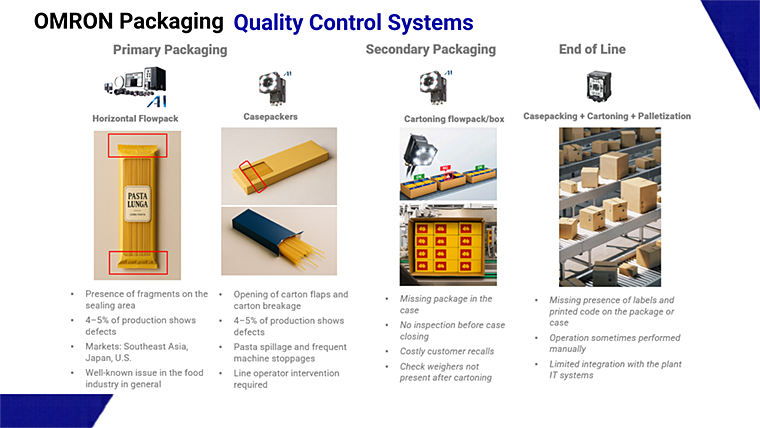
In today’s competitive business environment, the cost of a defect is more than just food wastage, spanning across downtime, recalls, regulatory exposure and most importantly customer trust. As per FDA Data on US food recalls in 2024, labelling errors alone accounted for 45.5% of the total recalls amounting to $1.92 billion in direct recall expenses. The consequences of recalls are harsher when manufacturers are dealing with customers beyond borders and regulatory authorities even stricter.
As a leader in industrial automation technology, OMRON works closely with manufacturers and machine builders to ensure productivity, quality, safety and consistency in food production. OMRON’s vision systems are one example of the value creation – combining hardware and software to enable machines to acquire, process and interpret images to perform automatic inspections, measurements and decision making without human intervention. Our collaboration with Ricciarelli, a global leader in pasta packaging sector is one of the recent success stories. In developing its latest horizontal cartoning machine designed for long pasta, Ricciarelli integrated OMRON’s FH vision system to verify the effective closure of the packaging and OCR/OCV marking. The machine operates 140 cartons per minute and is currently commissioned by a well-known Italian brand striving for zero defects.
As informed consumers demand manufacturers to explicitly disclose information such as ingredients, allergens, gluten-free, preservatives etc., the importance of product quality and packaging control is even greater than ever before. The collaboration conditions between food manufacturers and technology providers are also evolving with no room for error. OMRON will continue to develop technology based on the changing needs to contribute towards food safety.


