Corporate | Global
We are Shaping the Future!Showcasing Success Stories as We Innovate for a Sustainable Tomorrow
Nikkei 150th Anniversary Special Project
OMRON participated in a special advertising project by The Nikkei, centered on its renowned column “Watashi no Rirekisho” (My Personal History). Launched in 1956, the column has been featuring prominent figures from a wide range of fields—including politics, business, culture, and sports—who share their life stories, experiences, and personal philosophies.
To commemorate The Nikkei’s 150th anniversary, the project revisits the philosophies and aspirations of selected business leaders, who have been featured in the column, through interviews with current business leaders to explore how the ideas have influenced their companies and their vision for the future.
OMRON has a particularly distinctive connection to the column. Two members of its founding family—Kazuma Tateishi, OMRON’s founder, and Yoshio Tateishi, its third president—have both been featured in it. Only a limited number of companies have had two members of their founding family featured in the column. The special feature featuring OMRON was published in the morning edition of The Nikkei on October 5, 2026.
The following is a reproduction of the article:
OMRON leads the world in various businesses, including Industrial Automation business, by being among the first to introduce automation technologies. Looking back at the "Watashi No Rirekisyo (My Personal History)" written by the founder, Kazuma Tateishi, and the third-generation president, Yoshio Tateishi, it is repeatedly stated that the essence of the venture spirit lies in being the first to address customer issues and contributing to society through business. President and CEO Junta Tsujinaga re-reads the words of his predecessors and emphasizes, "We will faithfully continue the three pillars: being thoroughly customer-oriented, developing new growth markets, and managing in a way that brings out the potential of our employees."
As part of the Nikkei 150th Anniversary Special Project, we follow the legacy of the business leaders featured in the famous column that has run since 1956, exploring the present and future of companies that continue to take on new challenges.
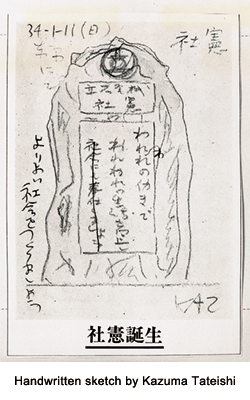
What made Kazuma exceptional was his commitment to putting the Company Constitution into practice. He established the "eight conditions" necessary for the company`s growth and incorporated them into his management. The eight conditions are: management philosophy, instinctive action, profit distribution, job satisfaction, management participation, new market development, independent technology, and leadership. These had a significant impact on OMRON's subsequent management.
For example, under the "new market development," he focused on the automation market ahead of others, opening up new markets such as manufacturing automation, automatic railway ticket gates, and traffic control systems, which led to the company's dramatic expansion. In later years, he expanded the business into health devices such as blood pressure monitors.
In "job satisfaction" and "management participation," he also maintained a management style that valued people and drew out their potential. In particular, he upheld the principle of "respect for humanity," placing employees above all else and maintaining a management style that drew out their potential. For example, he established a bold system called the "Producer System," under which young employees in their 20s and 30s were entrusted with managing spun-off factories. The system had two objectives : to give employees opportunities to experience the challenges of management from a young age and grow through their own efforts, while also fostering a culture of taking on challenges. Kazuma's management style, which encouraged employees to act autonomously while providing an environment in which they could demonstrate their potential, continues to be emphasized at OMRON today.
Kazuma was a wonderful manager who achieved many things. Those who knew him say he was a very strict person, but that was likely because he believed that customers and society, rather than himself, his family, or the company, should take priority, and that without them, a company cannot prosper. His attitude was even intimidating. Because he respected humanity and believed in people's potential, he maintained a management style that prioritized customers and society, refusing to compromise on himself or the company
When Kazuma, his father, asked him to become the third-generation president, Yoshio hesitated because, unlike his father and his older brother, the second president, he came from a sales background and was not well-versed in technology. However, he recalls that he made up his mind after Kazuma advised him, "You should look at technology and products from the perspective of the market, customers, and consumers."
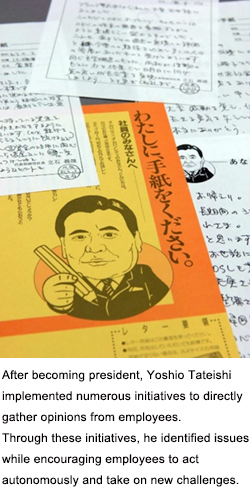
When Yoshio became president, he saw the reality within the company: the pace of management had slowed, and the company’s response to market and customer needs had become sluggish. Because Kazuma was a charismatic leader, a passive attitude of waiting for instructions had spread throughout the company. That was the "big-company disease" that Kazuma spoke of.
To overcome this challenge, Yoshio repeatedly engaged in dialogue with the employees supporting the front lines, seeking to understand matters from the perspective of the market, customers, and consumers. Believing that improving the company's internal structure was the fundamental solution, he took bold measures.
For example, the three-month "Long-term Refresh Leave" system for middle management. It was a bold measure to give managers time away from the workplace. I suspect that, in addition to wanting them to reflect on themselves, the goal was to ensure that teams could function even in the absence of managers. He encouraged autonomy on both sides. Like Kazuma, Yoshio also valued the autonomy of his employees.
I assumed the presidency in 2023. The guidelines I set upon assuming the presidency were to practice the corporate philosophy, return to a growth trajectory, and draw on Kazuma's life lessons to bring out the potential in people.
The reason I am committed to practicing the corporate philosophy is to contribute to society and our customers. I believe that we should dedicate all our efforts to being customer-centric. When I faced a significant deterioration in business performance immediately after assuming the presidency, I openly stated to the outside world that "customer-oriented activities have become diluted." As a result, a sense of urgency has been created within the company, and I feel that we have taken a step forward.
In the second stage, where we aim to return to a growth trajectory based on customer trust, I announced "Trusted Growth" in April. This is the first medium-term roadmap I have developed as president. The management issue I identified when I assumed the presidency was that while we were able to take short-term measures against immediate problems, we lacked sufficient consistent measures, over medium-to-long-term . To enable OMRON to grow again, we needed medium-to-long-term growth drivers that would allow us to pioneer markets that can contribute to society ahead of the rest of the world, just as the founder used the SINIC theory*1 to envision the future and work backward from it.
*1 SINIC theory (Seed-Innovation and Need-Impetus Cyclic evolution): A future prediction theory presented by Kazuma Tateishi and others at the International Society for Forecasting in 1970. This is the concept that science, technology, and society develop while mutually influencing each other, and it continues to live on at OMRON as a management compass.
To address this, I launched "GEMBA DX." To solve today's increasingly complex social issues, the use of data, in addition to hardware, is becoming increasingly important. We will combine the high-quality data obtained from our devices, one of our strengths, with other data, leveraging the field expertise we have cultiavted over many years. We will provide valuable information that can help address customers' essential issues. For example, in the factory automation field, there are "smart factories" that utilize AI, while in the healthcare field, there are preventive medical services optimized for each individual. We will develop new markets with OMRON's unique data solutions.
I also have a strong commitment to management that brings out human potential. First, I am implementing management that maximizes the company's cash-generating capability while ensuring that those who work hard to achieve results are appropriately rewarded. This follows the "High-Wage, High-Efficiency Management*2" advocated by Kazuma-san, which posits that higher wages boost employee morale and, as a result, inevitably improves productivity.
*2 High-Wage, High-Efficiency Management: One of Kazuma Tateishi's management principles. Management that aims for a virtuous cycle of improving corporate profitability by increasing employee productivity and efficiency, and returning those results to employees and society to foster development.
Specifically, I have appointed young people who lead next-generation management as heads of core businesses and key initiatives. I give them significant authority and hold them accountable for results. At the same time, the management team provides support to help them succeed. I have also established an evaluation system in which high rewards are obtained based on results. I believe that creating resources and opportunities for growth is one of the fastest ways to stimulate an entrepreneurial spirit.
I feel that the series of measures I have undertaken since becoming president are gradually making progress in the company. I believe that by continuing to accumulate successful examples, the company's culture and atmosphere will change. However, we are still only halfway there. What does a customer-centric approach mean, and how do we put it into practice? I want every employee to thoroughly pursue what this means and put it into action with complete dedication. By doing so, we should be able to earn greater customer trust and make more people happy.
On October 1, 2026, we transferred the electronic components business through a stock transfer. To remain a company that continuously solves social issues, it is essential to continually evolve our business portfolio. Currently, our four main businesses are control equipment, healthcare, social systems, and data solutions. I believe these are areas where new challenges will arise and intensify, as well as opportunities to meet the evolving needs of customers and society . However, further into the future, if the needs of the world and social issues change significantly, we may engage in businesses that are completely different from what we do today.
What will never change is that OMRON will continue to be a company that solves social issues, guided by its corporate philosophy. Moving forward, we will continue to practice the management philosophy inherited from our founding era and, with a customer-centric approach at the core, remain steadfast in our mission to solve social issues through our businesses.
*This content was originally written in Japanese by the Nikkei and translated into English by OMRON Corporation.


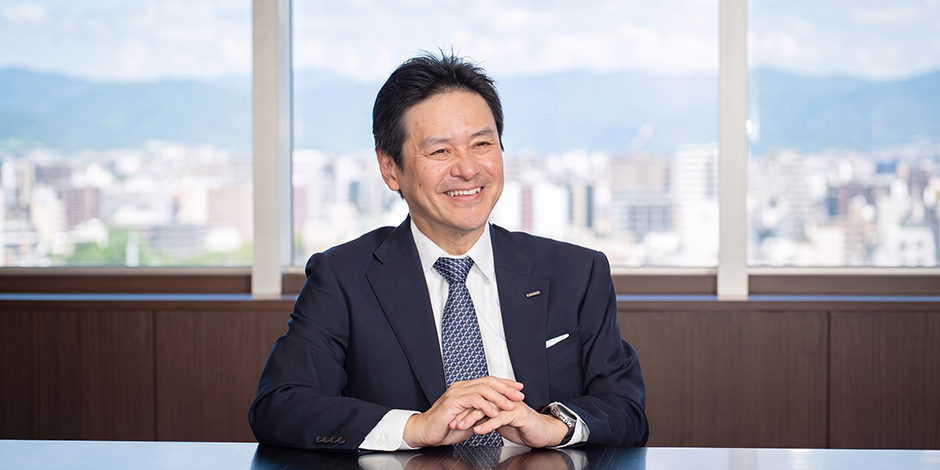
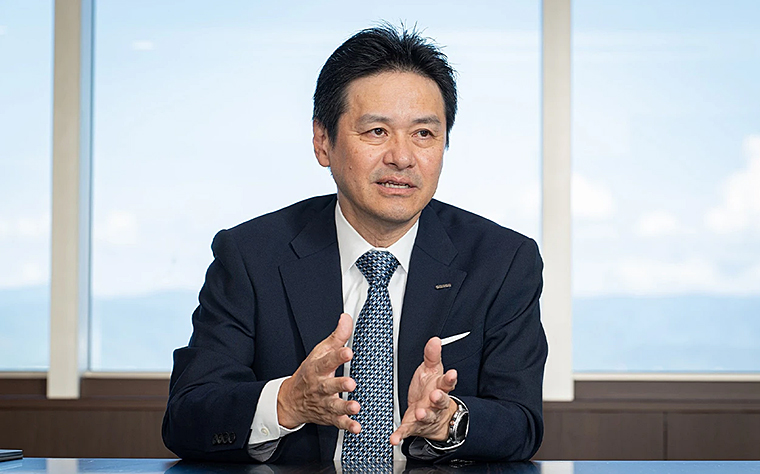
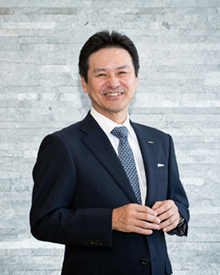 OMRON Corporation President and CEO Junta Tsujinaga