
Corporate | Global
We are Shaping the Future!Showcasing Success Stories as We Innovate for a Sustainable Tomorrow
IO-Link Devices Solve Everyday Manufacturing Challenges to EnableData Utilization
As labor shortages become more acute across the manufacturing industry, expectations are growing for digital transformation (DX) driven by AI and data utilization. However, relatively few production sites have successfully pursued DX to the full. OMRON believes that one of the fundamental barriers lies even earlier in the process—before data can be effectively collected, connected, and utilized.. How can manufacturers reduce the effort required for tasks such as sensor configuration, connection, and startup? This question led to the development of the GD Series IO-Link*1 Master Unit and the Wave Inspire HUB PC tool, both launched in 2026. We spoke with Mr. Yudai Tsuto and Mr. Yoshihide Yamamoto of OMRON’s Sensor Division within the Sensor Division, Product Business Division HQ, Industrial Automation Business Company about the fundamental challenges facing manufacturing sites today and OMRON’s efforts to accelerate data utilization.
*1: IO-Link is an international standard I/O interface (IEC 61131-9) that enables bidirectional digital communication between PLCs (programmable logic controllers) and sensors and actuators in factories and other settings. Unlike conventional ON/OFF signals, IO-Link can also exchange detailed diagnostic data and device configuration information, helping manufacturers anticipate equipment failures and reduce maintenance workloads.
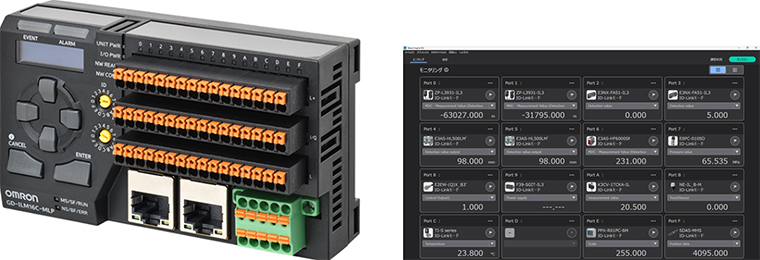 GD Series IO-Link Master Unit (left) | Wave Inspire HUB PC Tool (right)
Tsuto: The driving factor is, without question, the shortage of manufacturing talent.
With declining birth rates, aging populations, and an increasingly older skilled workforce, there is a growing shortage of people who can design, commission, and maintain production equipment. Against this backdrop, many manufacturers are looking to DX as a way to improve productivity.
However, our conversations with customers working in actual production sites revealed a different obstacle, one they must overcome before DX can even begin.
When people talk about DX, the discussion typically follows a familiar sequence: collect data, visualize it, analyze it, and use your insights to drive improvement. The reality on the factory floor, however, is that there is a great deal of work that comes before any of that. Sensors must be connected. Parameters must be configured. Communication settings need to be established. Data must be mapped to PLCs. Equipment-specific adjustments must be made. Each individual task might seem small, but when multiplied across an entire production line or facility, the burden becomes substantial. Even when manufacturers want to move forward with DX, they often find themselves consumed by the preparation work required to get there. This is the reality facing many production sites today.
 Mr. Tsuto, Sensor Division, Product Business Division HQ, Industrial Automation Business Company
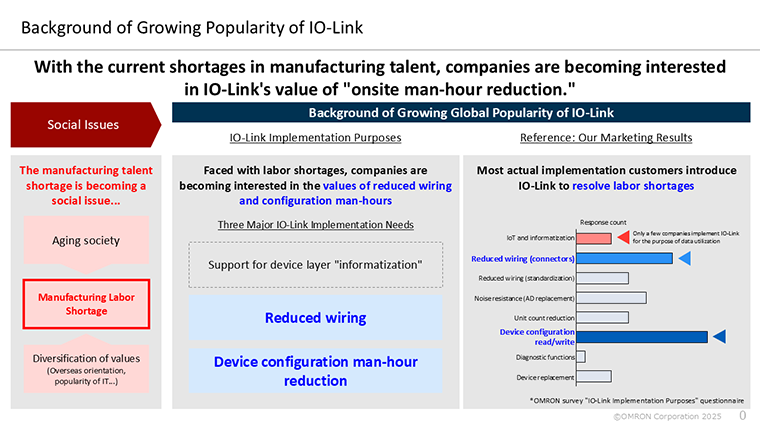
Tsuto: IO-Link is often understood as a communication standard for IoT and data utilization. That is certainly one of its important benefits. However, our market research and ongoing discussions with customers revealed a somewhat different reality. For many customers already adopting IO-Link, the primary goal was not data utilization itself. Instead, they were looking for benefits much closer to day-to-day operations, such as simplified wiring and reduced configuration effort.
Every time new equipment is commissioned, dozens of sensors must be configured one by one. This same work must be repeated whenever production facilities expand. If problems occur, you need to investigate the cause, verify settings, and restore operations.
These tasks are not at all glamorous. Yet they consume a tremendous amount of time and effort on the factory floor.
As labor shortages continue to intensify, what manufacturers truly needed was not an advanced DX system from the outset. They needed a way to reduce their immediate workload first.
That was the challenge we wanted to address.
This led us to the concept of “DX emerging naturally.”
Our goal is to first reduce the burden on the production floor. As a result, the foundation for data utilization is established naturally, paving the way for DX. We believe this approach is exactly what manufacturing sites need today.
Yamamoto: One of the biggest opportunities lies in the engineering phase.
With conventional IO-Link systems, engineers must first locate the appropriate IODD file*2 for each device, download it, and configure it. They also need to establish communication settings with the PLC. Individually, these tasks may seem minor, but when viewed across an entire production system, they become a significant burden. Using the GD Series and Wave Inspire HUB enables automatic recognition of devices from more than 100 manufacturers, and the task of configuring the necessary settings can also be automated. Moreover, the system can generate address comment tables required for PLC connectivity, significantly reducing engineering effort. What we wanted to achieve was an environment where engineers can focus on the crucial work of creating value through equipment and process design, rather than spending their time on configuration tasks.
We believe that building the foundation for DX begins in the engineering department.
*2: An IODD (IO Device Description) file contains detailed information about an IO-Link device, including the manufacturer, product number, functions, and parameter settings.
Yamamoto: Commissioning is a process that often becomes highly dependent on individual expertise.
In many cases, highly experienced engineers adjust sensor thresholds and deploy their know-how to achieve stable operation. However, as labor shortages intensify and the transfer of technical expertise becomes increasingly challenging, it is becoming more difficult to sustain this approach. Wave Inspire HUB allows users to save configuration settings and deploy them across multiple machines. This eliminates the need to repeat the same work over and over again, making it possible to standardize commissioning processes that used to be highly dependent on specific individuals.
In fact, some customers have told us that the workload involved in rolling out new equipment has changed dramatically.
Creating systems that support processes previously dependent on individual experience is one of the key points of value that we aim to deliver.
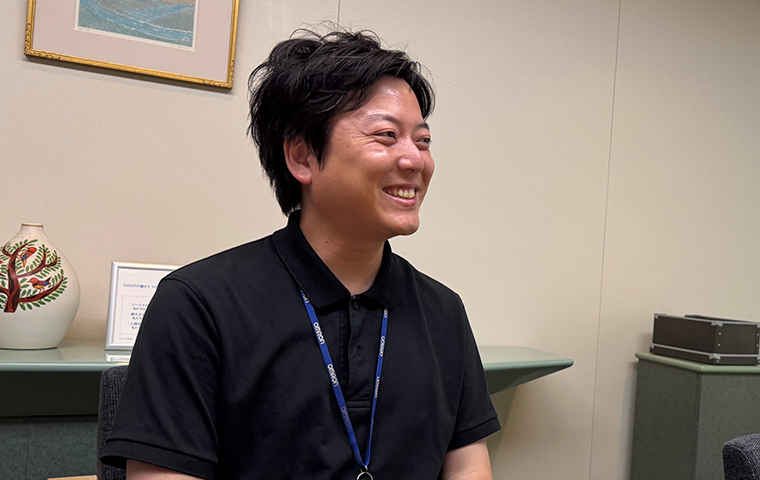 Mr. Yamamoto, Sensor Division, Product Business Division HQ, Industrial Automation Business Company
Yamamoto: The same challenge exists even after equipment has been put into operation.
For example, when a sensor fails, replacing the device itself is often less time-consuming than restoring its settings. If only a specific individual knows the configuration details, recovery can take much longer, resulting in a greater impact on production. The GD Series retains configuration information and can restore those settings to a replacement sensor. It also enables users to compare configuration differences and monitor device status. Our goal was not simply to respond after problems occur, but to create an environment where anyone can recover quickly when they do. In an era of labor shortages, we believe that maintaining stable equipment operation requires systems that do not rely solely on individual know-how or the experience of highly skilled technicians.
Yamamoto: One principle we place great importance on is openness.
Production sites typically contain equipment from a wide range of manufacturers. In reality, facilities composed entirely of OMRON products may be the exception rather than the norm.
That is why it is important not to create closed ecosystems centered only on our own products, but rather to support standards such as IO-Link and provide an environment that can connect easily with products from other manufacturers. In practice, customers on the factory floor are not concerned about differences between equipment vendors.
They want to keep their operations running reliably. They want to improve productivity. They want to make effective use of essential data.
We want to be the partner that helps make those goals possible.
We believe that an open approach is essential to advancing DX across the manufacturing industry as a whole.
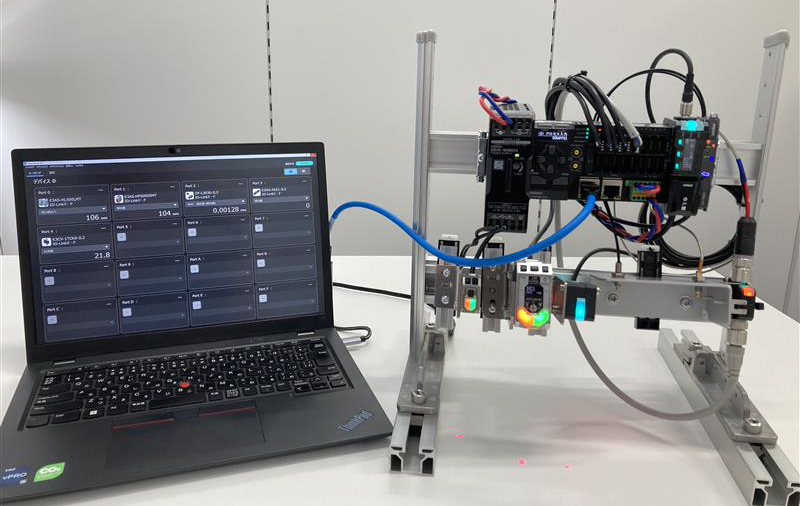 Wave Inspire HUB PC Tool (left) and IO-Link Product Lineup (right)
Tsuto: OMRON is currently driving its transformation into a GEMBA DX company as part of SF 2nd Stage.
At the heart of this transformation is the ability to turn data generated in manufacturing sites into valuable information. However, no matter how advanced AI or data analytics technologies become, they cannot deliver value if data cannot first be collected on the ground. That is why we are focusing on devices themselves. Making sensors easier to connect. Reducing the effort required for configuration, commissioning, and maintenance.
As a result, we can create an environment where shop floor data can be utilized naturally.
Our goal is not simply to provide communication devices.
It is to create the foundation for data utilization that will support the future of manufacturing, while also reducing the burden on the people working at the front lines.
DX, naturally. The first step is solving the challenges that exist before data utilization ever begins.
OMRON will continue to work alongside manufacturers, supporting the realization of GEMBA DX from the ground up.


