
Corporate | Global
We are Shaping the Future!Showcasing Success Stories as We Innovate for a Sustainable Tomorrow
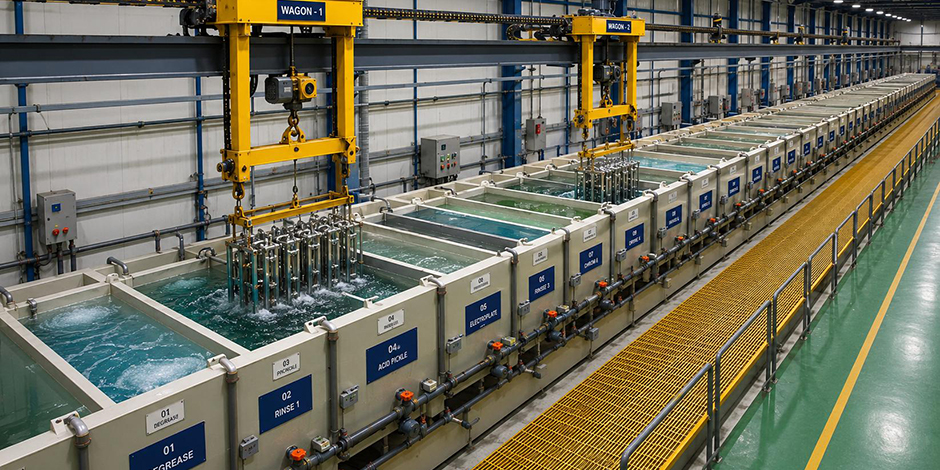
Making Chemical-Based Processes in Manufacturing Safer, Smarter, and More Resilient
In today's world of interconnected supply chains, safety is no longer just an operational aspect—it is one of the key drivers of business continuity and resilience. A single incident involving chemicals, temperature control systems, or process equipment can jeopardize employee safety, damage assets, disrupt production schedules, and most importantly erode customer confidence.
Whether in automotive manufacturing, digital or consumer electronics or semiconductors, chemical-intensive processes such as Anodizing and Electroplating are a critical part of the entire production process.
These are widely used electrochemical processes, prevalent in the manufacturing of automotive components, smartphones, consumer electronics, and industrial equipment manufacturing for enhancing durability, corrosion resistance, finishing and visual aesthetics of components and parts made of aluminum.
These processes involve multiple chemical, thermal, and electrical stages—including acidic electrolyte baths, electrolytic coloring, and high-temperature sealing. Maintaining stable operating conditions is critical as deviations such as variations in temperature, malfunctioning thermostats, inadequate liquid levels, drain valve failures, or control system faults can create unsafe conditions.
Managing safety in large-scale anodizing operations involving hundreds of tanks becomes increasingly challenging when relying solely on conventional methods. If these risks are not detected and mitigated in real time, the consequences can be severe, ranging from equipment damage to fire incidents and production loss.
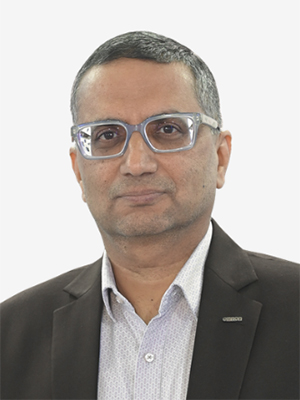
Sameer Gandhi, MD, OMRON Automation, India, explains,
“The challenge is not unique to Anodizing and Electroplating only. It’s about the legacy process lines across manufacturing sectors, which continue to rely on fragmented control systems, standalone safety devices, or manual interventions that may not provide the level of protection required in today's high-volume and demanding production environment. As factories become more complex, safety systems must evolve beyond compliance-driven approaches toward intelligent, integrated protection mechanisms capable of identifying abnormalities before they escalate into incidents.”
Modern automation technologies enable manufacturers to create multiple layers of protection around critical processes through redundant and integrated safety-rated control systems.
The question facing manufacturers is therefore not whether to invest in safety, but how to build systems that can proactively prevent incidents rather than merely respond to them while also digitizing operational data directly at the production floor and transforming safety-related events and operational insights into actionable intelligence—a concept OMRON refers to as GEMBA DX. This is where industrial automation plays a transformative role.

According to Holabasappa Parit, Section Manager-Industrial solutions and Services Department, OMRON Automation, India, who has been playing a key role in successful execution of projects dealing with automation-led safety,
“Unlike conventional control systems, integrated safety architecture ensures safe operation even when individual components fail. For Anodizing, particularly, critical parameters such as temperature, liquid levels, pressure, flow rates, and equipment status can be monitored continuously, while automated shutdown mechanisms prevent hazardous situations from escalating. The result is a manufacturing environment that is not only more productive but also inherently safer.”
In large-scale Anodizing facilities, where hundreds of process tanks may operate simultaneously, traditional safety management approaches are often insufficient to address growing operational complexity and risk.

Explaining one of his successful projects, in India, dealing with such large-scale Anodizing, Kumaresan V, Product Manager – Safety, OMRON Automation, India, shared:
“Most of the times, the Anodizing tanks have PLCs for process control, and also have controls for temperature, liquid level, heater control, and drain valves. But they do not have Safety PLCs, meaning there is no independent or integrated safety layer to meet modern functional safety requirements.”
Team OMRON comprehended that simply replacing the entire control system would require rewriting all machine and safety functions, creating cost, complexity, and downtime and the existing PLCs could not directly support the newer proposed safety controller-based architecture. Hence, instead of replacing the machine controls, OMRON implemented a parallel safety architecture that retained the existing PLCs for normal process operations, however added safety controllers (NX502 + NX-SL5700) as an independent safety system.

Elaborating on the value delivered by OMRON, Prabu Ulaganathan, Industry Manager – Digital, said :
"A key success factor in this project was our Machine Safety Engineering (MSE) expertise. By working closely with the customer, our team thoroughly evaluated the application requirements, conducted a comprehensive risk assessment, and developed a robust safety concept tailored to a complex automation environment. This collaborative approach not only strengthened the customer's confidence but also positioned OMRON as a trusted advisor, enabling us to deliver a safe, reliable, and future-ready automation solution."
The team also connected safety I/O modules to monitor critical process parameters and established a Fail Safe over EtherCAT (FSoE) safety network.
The architecture integrates Safety PLCs, HMIs, SCADA, EtherCAT networks, and existing control systems into a unified platform, avoiding costly replacement of installed equipment. This demonstrates how integrated safety can be achieved with minimal disruption to production while maximizing the return on existing asset investments.
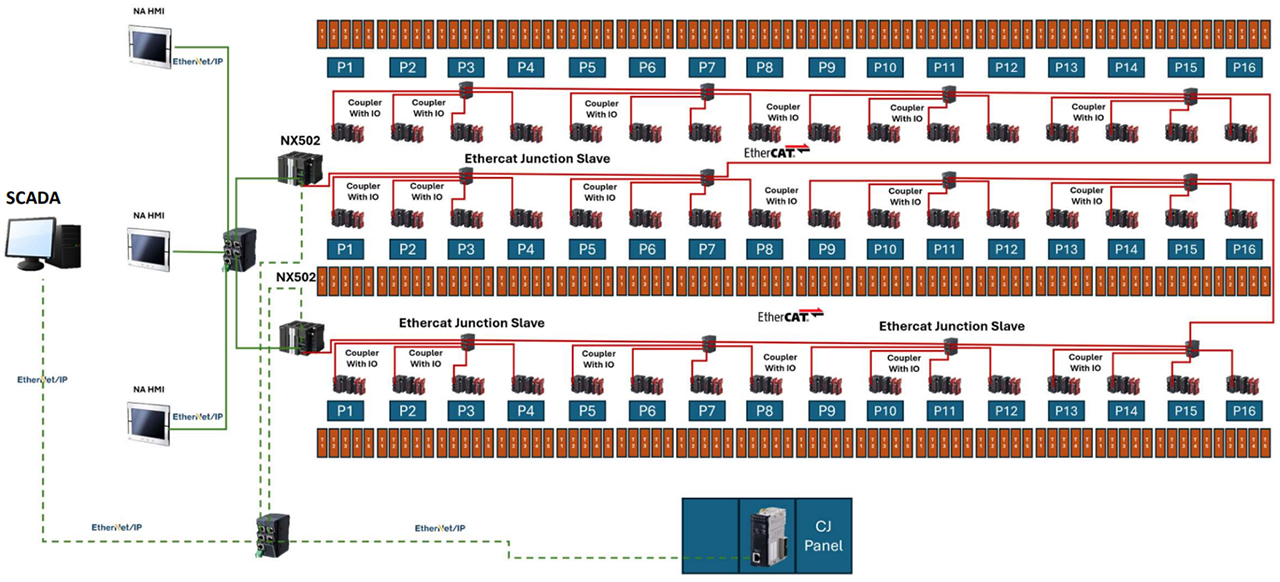 Illustration of the solution architecture
This independent safety layer supervises temperature control, liquid level, heater control, and drain valves and enables the safety system to intervene and place the process into a safe state if abnormal conditions were detected. It also eliminates dependence on the original overseas machine builder for future modifications and created a scalable architecture that could later support diagnostics, traceability, analytics, and digitalization initiatives.
Instead of isolated safety devices, the plant now benefits from centralized oversight and coordinated safety responses across hundreds of its Anodizing tanks, reducing the likelihood of process failures escalating into major incidents.
The architecture is designed to expand as production grows, allowing additional process lines, tanks, and safety functions to be incorporated into the same framework.
By digitalizing safety data across the production floor, OMRON helps manufacturers build the foundation for GEMBA DX and smarter operations.
The new safety architecture:
・Digitally monitors critical process conditions.
・Provides real-time visibility into safety-related events.
・Creates structured data that can be used for predictive maintenance and operational improvement.
・Forms the foundation for future smart factory and process optimization initiatives.
“As manufacturers embrace digital transformation, safety can no longer exist as a standalone function or a protective measure. It must become part of a broader operational intelligence framework and a strategic enabler of operational excellence. Safety systems generate valuable operational data. By analyzing trends and identifying abnormal conditions early, manufacturers can shift from reactive maintenance to predictive risk management, significantly reducing the likelihood of incidents”, added Sameer Gandhi.
This aligns closely with the concept of GEMBA DX at OMRON—bringing digital transformation directly to the manufacturing floor where value is created through the integration of operational technology (OT) and information technology (IT).
As manufacturing facilities become larger, more automated, and increasingly dependent on chemical-intensive processes, the margin for error continues to shrink.
OMRON has the capability to transform safety from a machine-level function into a plant-wide protection framework capable of safeguarding large-scale chemical manufacturing operations.
In India, for industries ranging from automotive and electronics to semiconductors and advanced manufacturing, proactive safety, enabled by intelligent automation, will be a defining characteristic of the next generation of world-class manufacturing operations.


