
Corporate | Global
We are Shaping the Future!Showcasing Success Stories as We Innovate for a Sustainable Tomorrow
OMRON’s Data Flow Controller links shop floor efficiency with business strategy
With Japan’s declining working-age population showing no signs of slowing, digital transformation (DX) is an increasingly urgent priority for management. The manufacturing sector is no exception to this trend—over the past 20 years, the number of workers in the manufacturing sector has fallen by more than 1.5 million*, creating a serious labor shortage across the industry. Although many manufacturers have responded by undertaking DX initiatives to improve productivity, a number of challenges continue to stand in the way of successful implementation.
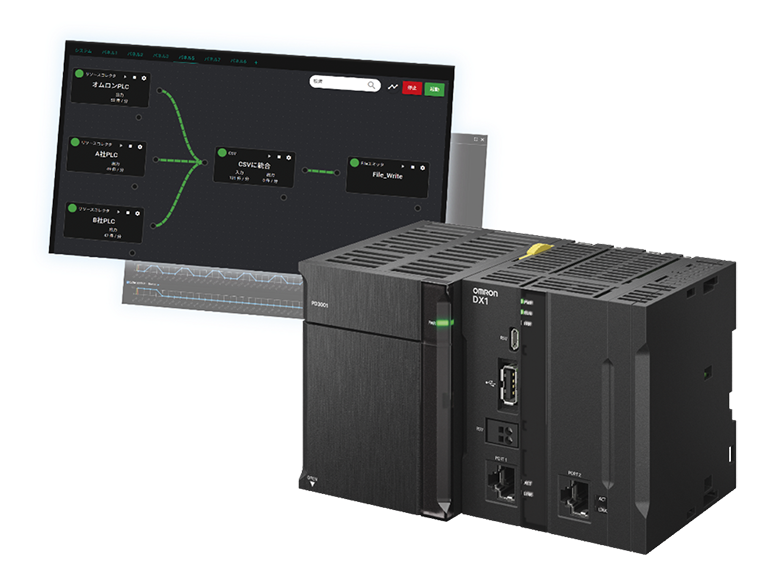
In September 2025, OMRON launched the Data Flow Controller (hereafter, Data Flow Controller), an innovative edge controller designed to dramatically accelerate the use of manufacturing data. Installed alongside control devices such as sensors and programmable logic controllers (PLCs), Data Flow Controller enables users to collect, analyze, and visualize production data on a single device, without the need for specialized programs or separate software applications.
Developed to help manufacturers overcome the barriers to digital transformation & sustainability, Data Flow Controller was created with a clear vision of making it easier for users to access and utilize plant data. We spoke with Mr. Takuya Ueki of OMRON’s Controller Division, who played a key role in the product's development within OMRON’s Industrial Automation Business, to learn about the concept behind Data Flow Controller and the value it delivers to customer manufacturing sites.
*Source: Ministry of Economy, Trade and Industry, White Paper on Manufacturing Industries 2024
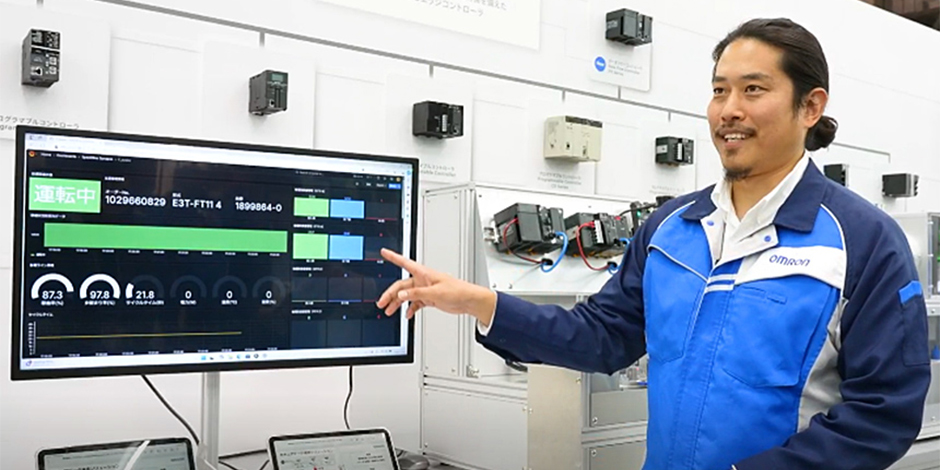
 Mr. Ueki of OMRON’S Controller Division (Product Business Division HQ, Industrial Automation Company)
Today’s manufacturers are expected to achieve more than just higher productivity and improved quality. They must also reduce their environmental footprint, including greenhouse gas (GHG) emissions, balancing manufacturing excellence with sustainability. In order to optimize energy efficiency and eliminate waste, manufacturers first need to collect and make effective use of operational data from across the production floor. In other words, integrating Industrial Internet of Things (IoT) technology has become a key prerequisite for achieving sustainable manufacturing.
However, implementing this in practice presents three significant challenges.
The first is a severe shortage of personnel with digital expertise. It is unrealistic for all plants to employ highly specialized IT professionals such as data scientists, and in practice, manufacturing improvements often depend on the judgement of experienced engineers on the shop floor, who continue to refine processes through trial and error.
The second challenge is that methods for collecting and utilizing production data are not standardized. Manufacturing sites typically operate a range of equipment of different ages, controlled by PLCs and other devices supplied by multiple manufacturers.
The third challenge is the risk of impacting existing production equipment. In many cases, collecting data from machinery while in operation requires modifications to the existing PLC control programs. This introduces the risk of production stoppages and extensive validation work, necessitating significant time and cost. As a result, many manufacturers are hesitant to embark on DX initiatives, despite understanding the importance of data utilization.
Accordingly, although DX has become a strategic priority for management, these barriers continue to prevent many companies from translating their ambitions into concrete action.
The guiding principle behind Data Flow Controller can be summed up in a single phrase: a platform that allows anyone to start utilizing data from tomorrow, without stopping existing production equipment. Advanced IT systems often require substantial investment, lengthy implementation projects, and ongoing costs whenever system specifications change. They may also require production equipment to be taken offline during installation, resulting in costly interruptions to manufacturing. What manufacturing customers were really looking for was an intuitive interface that enables shop floor operators and maintenance personnel to collect and visualize data themselves, while allowing existing production lines to remain in operation.
Manufacturers also wanted greater flexibility in connecting production equipment. Since PLCs from different vendors are commonly used for different production processes and machines, there was strong demand for a solution that could collect data not only from OMRON PLCs but also from third-party controllers through simple retrofit installation. Another important requirement was the ability to present data in ways that match the needs of different users. Plant managers need a high-level view of operations across the facility, while engineers working on the shop floor require detailed information about individual machines and production processes. Accordingly, there was strong demand for a system capable of organizing and displaying information at the appropriate level of detail for diverse users.
Data Flow Controller builds on the reliability of Sysmac, OMRON’s control platform developed over many years, while introducing a controller dedicated to data utilization at the edge. The concept behind its development was simple: integrate all the functions required for collecting and utilizing manufacturing data in a single hardware device. At the same time, the development team focused on two priorities critical to engineers working on the shop floor: ease of use and ease of connectivity.
Conventional data collection systems typically require multiple components—a controller gathers production data, a PC running middleware stores and processes this data, and separate software is then used to visualize the results. Even installing dedicated software on company PCs can place a significant burden on manufacturers, often requiring approval from corporate IT and cybersecurity departments as well as ongoing maintenance whenever operating systems are updated.
Data Flow Controller takes a fundamentally different approach. The controller comes with middleware* for data processing and analysis, together with a web-based dashboard tool, pre-installed as part of the standard package. As a result, there is no need to install dedicated software, build servers, or configure complex IT infrastructure. Users can simply connect Data Flow Controller to an existing network, and begin collecting, analyzing, and visualizing production data using dashboards—all within the same day. Reducing these barriers to implementation was top priority for the development team during the product development process.
*Data Flow Controller incorporates SpeeDBee SynapseR middleware from SALTYSTER Inc.
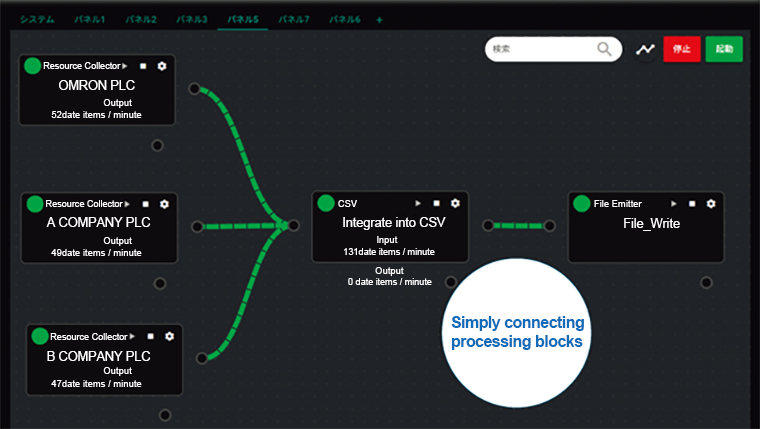
As previously mentioned, manufacturing sites rarely consist of equipment from a single supplier. Production lines often combine controllers and automation equipment from multiple manufacturers, making interoperability essential. Accordingly, Data Flow Controller was specifically designed to connect not only with OMRON PLCs but also with PLCs from Japan’s leading manufacturers*. Existing equipment can continue operating without interruption, and production data can be collected simply by connecting an Ethernet cable, without modifying the PLC’s control program (ladder program). This significantly reduces both implementation lead time and initial investment costs while eliminating the need to stop production during installation.
*Compatible PLC series include: Mitsubishi Electric: MELSEC Series; JTEKT: TOYOPUC Series; KEYENCE: KV Series; Panasonic: FP Series; OMRON: NJ, NX, CKCS, CJ, CP, and NSJ Series
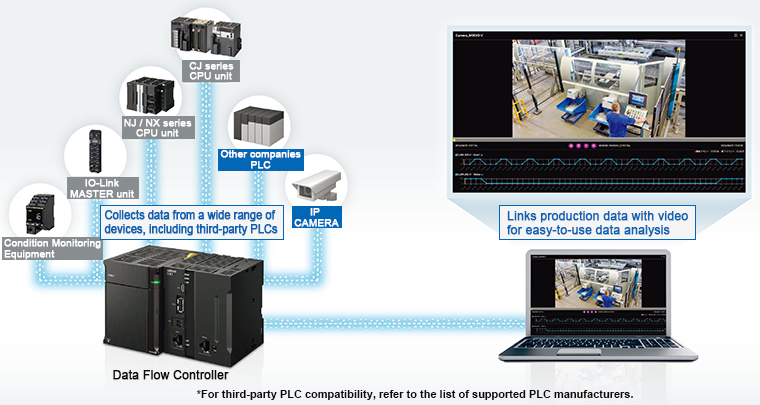
In May 2026, OMRON further enhanced Data Flow Controller via a major software update that significantly expanded both its data collection capabilities and system connectivity. One key upgrade was the addition of OPC UA Client functionality, together with support for Siemens communication protocols. OPC UA is widely adopted as the standard industrial communication protocol across Europe, and these additions expand Data Flow Controller’s capabilities for use in global manufacturing environments. Support was also added for connecting legacy equipment through serial converters, enabling manufacturers to incorporate older production machinery into their digital transformation initiatives alongside newer equipment.
This update further improves connectivity with OMRON devices through automatic device detection, while also enhancing compatibility with IO-Link devices. In addition, new database connectivity and spreadsheet integration functions make it easier to transfer collected production data directly into business systems and analytics environments. Together, these enhancements enable manufacturers to seamlessly connect data from across the production floor and immediately utilize it in their operational and management systems.
*OPC UA (Open Platform Communications Unified Architecture) is an open-source international standard designed to enable secure and reliable data exchange in industrial automation and other industries.
*IO-Link is an open communication technology defined by the international standard IEC 61131-9 for communication between sensors, actuators, and I/O terminals.
Data Flow Controller is initially aimed at manufacturers who have fully operational production facilities but have yet to take the first step toward digital transformation, as well as small and medium-sized manufacturers for whom large-scale investments in IT infrastructure is not feasible. By enabling production data to be visualized in real time according to specific user needs, Data Flow Controller helps accelerate continuous improvement efforts on the shop floor while streamlining the process of reporting to management. This ultimately supports faster, data-driven decision-making across the organization (data-driven management). OMRON has already developed dashboard packages tailored to specific user needs, allowing production teams and management to communicate based on the same data and a shared understanding of operational performance.
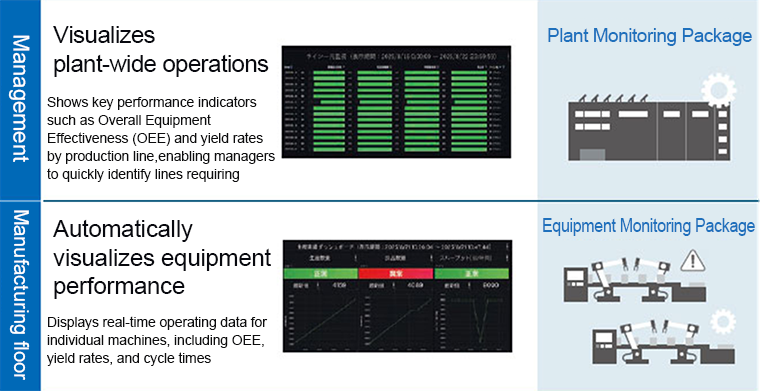
Looking ahead, OMRON plans to continue expanding and enhancing Data Flow Controller through additional templates and application functions that make it easier to flexibly and promptly address the unique challenges faced by different manufacturing sites. Future upgrades will include functionality optimized for specific industries, together with solutions that help manufacturers respond to growing societal demands such as energy efficiency and carbon neutrality. The ultimate goal is to enable customers to utilize manufacturing data in a manner optimized to their specific objectives and operating environments.
Data Flow Controller is intended to be a product that will continue evolving through close collaboration with customers. By incorporating customer feedback into ongoing product development, the product has continued to evolve as a device that links data across the production floor since its initial launch in September 2025. Going forward, OMRON will continue to respond swiftly to emerging data utilization needs in manufacturing by shaping Data Flow Controller into a data platform that adapts and grows alongside its customers—rather than simply providing a product. To this end, OMRON aims to stay closely attuned to the need of the production floor and continue delivering solutions that create lasting value for customers.
In 2021, OMRON announced its long-term vision, SF2030 (Shaping the Future 2030). In 2026, the company entered the next phase of this vision with SF 2nd Stage. The company is currently working to advance its core Sensing & Control + THINK technology while developing solutions that combine its strengths in devices and data. Throughout its history, OMRON has constantly anticipated emerging societal needs and responded to them through automation technology. Going forward, OMRON will continue creating innovations that connect the manufacturing floor with the future of industry.
The DX100 Data Flow Edge Device
https://automation.omron.com/en/us/products/family/DX100


