
Corporate | Global
We are Shaping the Future!Showcasing Success Stories as We Innovate for a Sustainable Tomorrow
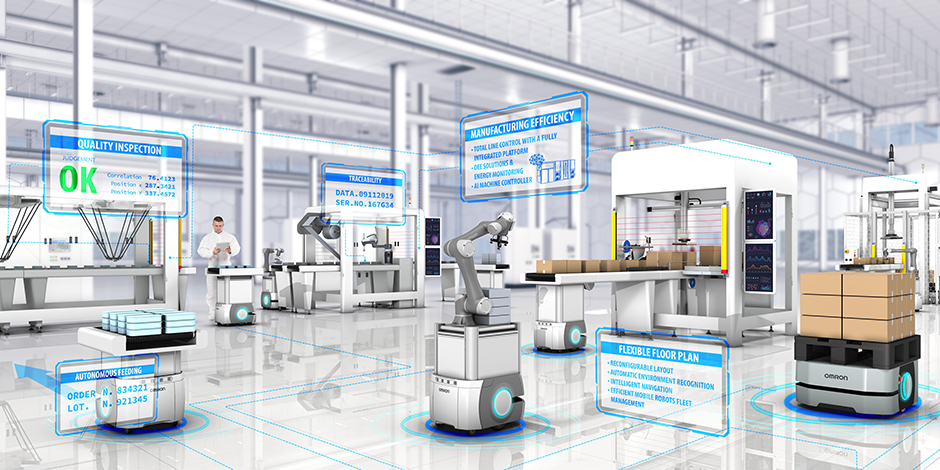
From factory floors to home healthcare, OMRON aims to turn high-quality, on-site data into practical solutions that support workers, strengthen industries and improve everyday life globally.
For more than 250 years since the first Industrial Revolution, manufacturing has been shaped by persistent imbalances—between regions, industries, and roles. Industry 4.0 has made progress, but high costs, uncertain ROI, and legacy constraints still prevent many manufacturers from scaling digital transformation. As a result, productivity and expertise are not evenly distributed across sites and workers, limiting broader industrial competitiveness and slowing the pace of innovation across sectors.
OMRON, a global technology company with more than 90 years of value creation, believes the next era of manufacturing will be co-created with partners and built on what already exists on factory floors: high-quality data generated close to real work. This shift marks a move from isolated automation toward more connected, data-driven ecosystems.
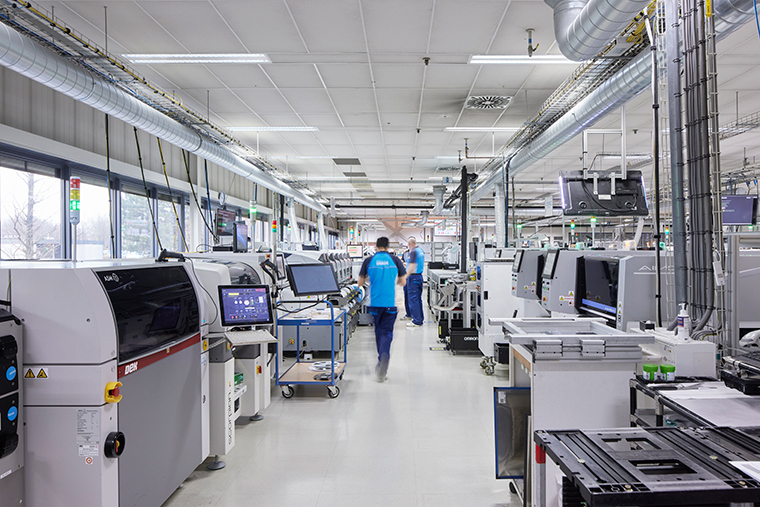 OMRON's factory in the Netherlands
From his office overlooking Kyoto, Junta Tsujinaga describes value creation as something that extends beyond a company to society at large. “OMRON is well known for control equipment that supports factory automation and healthcare products like blood pressure monitors,” he says. “With approximately 45 percent of our sales coming from factory automation, China has been a key growth driver.”
As the Chinese market slowed, OMRON returned to the drawing board to rebuild a company more resilient to external shocks. This coincides with Japan’s own challenges, including population decline, labor shortages, and supply chain uncertainty. “We need to enhance our capabilities not only to transform OMRON, but also to strengthen the value chain that has supported Japan’s manufacturing leadership,” he says.
OMRON’s strategy—what Tsujinaga calls “transforming into a Gemba DX company”—starts with the place where value is created. Gemba means “the real place.” “For OMRON, Gemba is the factory floor where our control equipment is deployed,” he says. “A factory floor is a complex scene which incorporates different kinds of cutting-edge technologies such as programmable logic controllers (PLCs), sensors, vision cameras, robots etc. In addition, factories employ human workers with unique skills to execute various tasks. There are three key elements to ensure smooth operations – machine to machine communications, human to machine communications and human to human communications backed by actionable data to boost productivity and efficiency.”
In manufacturing, labor shortages and skill gaps remain key challenges. OMRON combines data from sensors and programmable logic controllers (PLCs) with the tacit knowledge of workers, supported by AI-enabled analytics. The aim is to streamline operations, improve decision-making, and automate repetitive tasks—so that expertise can be shared more widely and performance becomes less dependent on individual experience. This approach helps create a more accessible and sustainable environment for manufacturing over time, while preserving human know-how as a core asset.

Junta Tsujinaga, President & CEO, OMRON
OMRON’s DX1 Dataflow Controller has emerged as a key offering to address the limitations that have long plagued the manufacturing industry to realize digital transformation. The product can be retrofitted onto existing production lines, works with equipment from other manufacturers, and requires no advanced programming skills. This makes digital transformation realistic for manufacturers that cannot replace legacy systems. Ultimately, OMRON aims to turn high-quality, on-site data into solutions that raise productivity, address labor shortages, and build a more resilient ecosystem, reinforcing the connection between data, people, and real-world value creation.
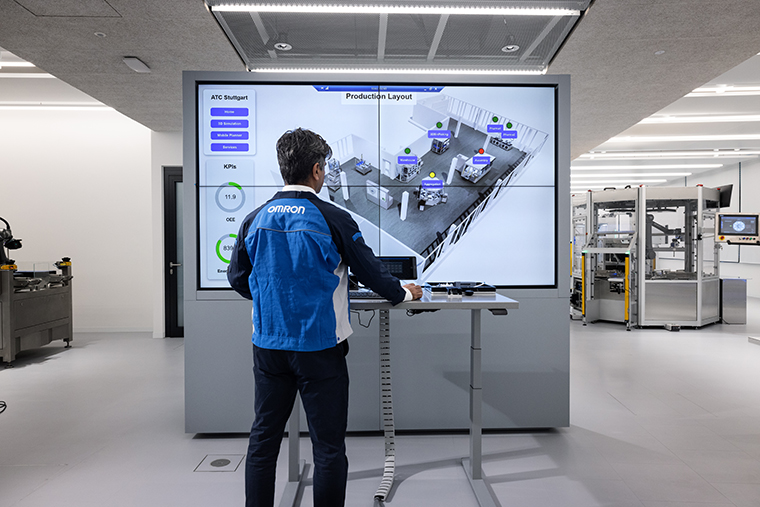 An engineer remotely monitoring production layout
In healthcare, OMRON takes a similar approach by analyzing vital-sign data collected from devices such as blood pressure monitors and combining it with medical and health screening data. By transforming high-quality data into actionable insights, the company helps detect health risks at an earlier stage and supports both preventive care and post-treatment management. “Gemba DX has the versatility to create customer value across many scenarios,” Tsujinaga says, “and we are leveraging it to address broader social challenges.”
*This content was originally published in Newsweek International Magazine, July 3, 2026 edition, and was written by Bernard Thompson.


