
Corporate | Global
We are Shaping the Future!Showcasing Success Stories as We Innovate for a Sustainable Tomorrow





In line with World Hypertension Day on May 17, the global awareness campaign known as May Measurement Month (MMM), is held every May to promote the importance of blood pressure measurement. *1
Behind this lies hypertension, which remains a major global health challenge and one of the leading causes of death. Hypertension is often referred to as the “silent killer” because it can develop without noticeable symptoms while increasing the risk of serious conditions such as stroke and heart attack. Today, an estimated 1.4 billion people around the world are living with hypertension. *2
However, hypertension can often be detected early and managed effectively. Regular blood pressure monitoring plays a vital role in this effort. As a simple habit that can easily be incorporated into daily life, it supports the early detection and effective management of hypertension.
OMRON has been working for more than 60 years on home blood pressure management and on developing medical-grade devices that help support hypertension treatment for patients and healthcare professionals. The journey began in the early 1960s, when founder Kazuma Tateishi advanced the concept of Health Engineering using automation technology to support health management and the diagnosis and treatment of disease, and through this vision, OMRON pursued research and development of home blood pressure monitors.
By extending healthcare beyond hospitals and into the home, we aim to help prevent disease before it develops.
In 1973, OMRON launched its first digital blood pressure monitor. Since then, we have promoted the adoption of home blood pressure monitoring by delivering both the accuracy trusted by healthcare professionals and the ease of use that enables people to incorporate monitoring into their daily lives.
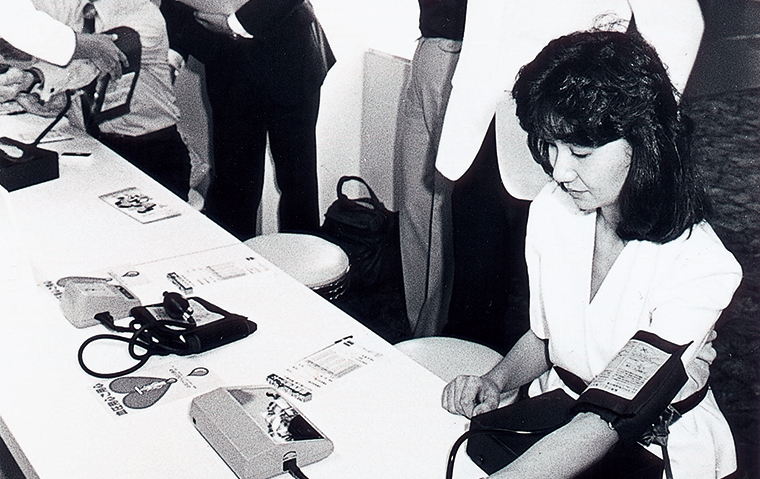 Measuring blood pressure using
a home blood pressure monitor (1983)
Measuring blood pressure using
a home blood pressure monitor (1983)
In 1986, the large-scale community-based research project known as the Ohasama Study, which helped formulate 135/85 mmHg as the global standard for home blood pressure, was launched in Ohasama Town, Iwate Prefecture (now Hanamaki City). For this study, the first in Japan to introduce home blood pressure monitors for research, OMRON provided approximately 300 blood pressure monitors and helped demonstrate the value of the new health practice of measuring blood pressure every day at home.
This study was the first in the world to demonstrate that home blood pressure can more accurately predict future disease risk than clinic blood pressure.
It continues to this day, approximately 40 years after it began. Furthermore, this research led to the establishment of the home blood pressure reference value of 135/85 mmHg and was adopted in international hypertension guidelines, helping elevate home blood pressure to a global standard. *3
OMRON continues to collaborate with healthcare and public health professionals to help foster a culture of regular blood pressure monitoring and promote home monitoring around the world. Today, cumulative global sales of OMRON blood pressure monitors have exceeded 400 million units across more than 130 countries and regions.
However, this culture of regular blood pressure measurement has not yet spread widely enough around the world. Approximately two-thirds of people with hypertension live in low- and middle-income countries, where it remains a serious health challenge.
Through the MMM campaign, OMRON works with hypertension societies, healthcare professionals, and public health organizations around the world to promote regular blood pressure measurement and home blood pressure monitoring.
In the Philippines, from May to July 2026, OMRON is partnering with the Philippine Society of Hypertension to conduct free blood pressure screenings nationwide under the message "One measurement can save a life." In the Philippines, where one in three adults aged 30-79 (about 16.8 million people) is estimated to have hypertension, *4 OMRON is helping improve people’s lives by raising awareness of the importance of early detection and ongoing management.
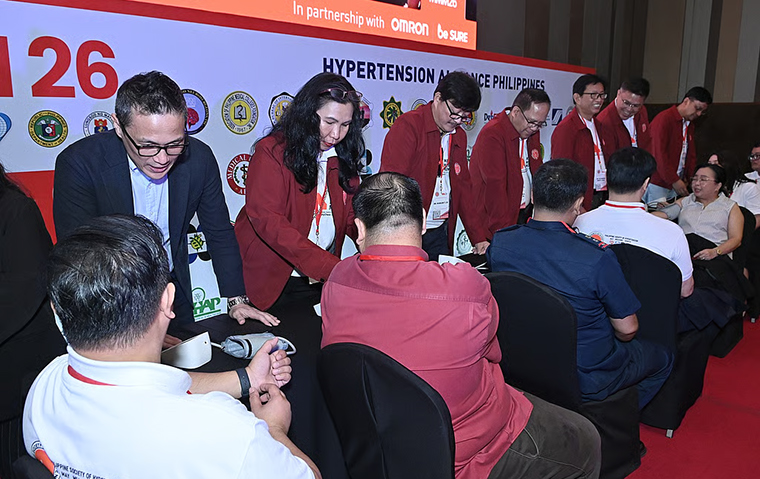 Blood
pressure measurement ceremony: (from left) OMRON Philippines General Manager
Benjamin Agbulos
Blood
pressure measurement ceremony: (from left) OMRON Philippines General Manager
Benjamin Agbulos
and Philippine Society of Hypertension encouraging people to
monitor their blood pressure
Preventive
healthcare is advancing to the next stage.
In 2016,
OMRON developed OMRON
Connect, a
health management app that enables users to track their own vital data. Today,
it has been downloaded more than 15 million times across over 130 countries and
regions, helping to pioneer the first steps toward preventive healthcare.
Looking ahead, OMRON aims to connect vital data measured at home with clinical
care, further strengthening the link between personal health management and
professional medical care.
Furthermore, through co-creation with global partners, OMRON is accelerating the development of digital health solutions that support the full continuum of care, from prevention to remote healthcare.
In Europe, in 2024, OMRON acquired Luscii Healthtech B.V. of the Netherlands as a wholly owned subsidiary. Luscii’s services are used in more than 70% of hospitals in the Netherlands, and programs covering over 200 diseases are offered, strengthening remote patient monitoring services.
In India, where the number of medical specialists is estimated to be only about 4% of that in Japan, OMRON partnered with Tricog Health in 2023 to launch a remote monitoring service for cardiovascular diagnostic support, combining cutting-edge AI analysis built on more than a decade of ECG data. Even in regions facing specialist shortages, OMRON aims to enable earlier diagnosis and improve access to healthcare, contributing to preventive care and improve health outcomes in India.
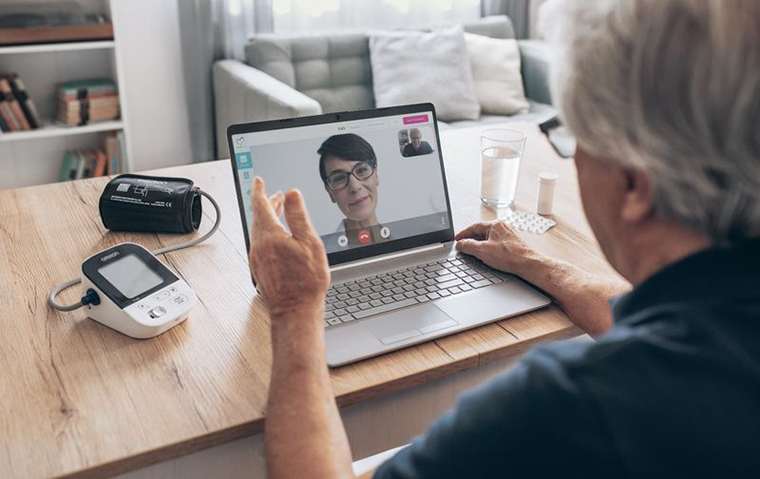 A real-world example of a future remote
healthcare service model
A real-world example of a future remote
healthcare service model
OMRON is working to address healthcare challenges around the world by developing new solutions that seamlessly connect the journey from early detection to diagnosis and treatment.
Going forward, OMRON will continue to advance and expand access to its clinically validated healthcare devices around the world, while creating new value through collaboration with partners. By connecting innovation, data, and care, we aim to help people live healthier lives and contribute to a better society.
*1: May Measurement Month
A global blood pressure awareness campaign led by
the International Society of Hypertension in conjunction with World
Hypertension Day on May 17. Launched in 2017 to raise awareness of the
importance of blood pressure measurement and the risks of hypertension, the
campaign has reached more than 7 million people worldwide and identified more
than 1 million individuals with previously untreated hypertension.
*2: "Global report on hypertension 2025: high
stakes: turning evidence into action,"
https://www.who.int/publications/i/item/9789240115569
https://www.who.int/news/item/23-09-2025-uncontrolled-high-blood-pressure-puts-over-a-billion-people-at-risk
*3: History
of Establishing the Home Blood Pressure Reference Value "135/85 mmHg"
1986:
Ohasama Study launched
1996: Ohasama Study adopted in the U.S. Joint
National Committee guidelines
1999: Ohasama Study adopted in WHO guidelines
2000: Japanese Society of Hypertension publishes
its first "Guidelines for the Management of Hypertension"
2004: Ohasama Study adopted in the European
Society of Hypertension guidelines
2009: Japanese Society of Hypertension
"Guidelines for the Management of Hypertension 2009" sets home blood
pressure reduction targets at "below 125/80 mmHg (below 135/85 mmHg for
elderly)"
2014: Japanese Society of Hypertension "Guidelines for the Management of
Hypertension 2014" stipulates priority of home blood pressure for
hypertension diagnosis
2015: Ohasama Study adopted in the Taiwan
Society of Hypertension guidelines
*4: Approximately one
in three adults aged 30-79 (about 16.8 million people) are estimated to
have hypertension in the Philippines
https://www.who.int/westernpacific/newsroom/feature-stories/item/stronger-systems-for-healthy-hearts-in-the-philippines


