
















A Conceptual Validation of the Evolution and Standardization Technologies of FA Systems in the Data Era
- Digital Twin
- AAS
- OPC UA
- Carbon Footprint
The importance of data utilization in manufacturing has rapidly increased in recent years. Factory automation (FA) systems are shifting from control-centric to data-centric architectures driven by advances in IoT, AI, and cloud technologies. This paper presents OMRON’s proof-of-concept (PoC) implementation, which verified six use cases: product lifecycle traceability, visualization of environmental impact, customer information disclosure, smart maintenance, flexible production lines, and automation of shipping and inspection. By leveraging such standardization technologies as Asset Administration Shell (AAS), OPC UA, and GS1 Digital Link, it is possible to build a unified data utilization platform that enables collaboration among the shop floor, design, and management layers. This enabled comprehensive traceability throughout the product lifecycle, visualization of environmental and quality information, improved operational efficiency, and enhanced reliability across the supply chain. In the future, collaboration with AI and data analytics, adaptation to industry standardization, and global expansion will be necessary to contribute to sustainable manufacturing.
1. Introduction
In recent years, manufacturing companies have undergone a major shift in the operating environment. Amid a rapid increase in the importance of data utilization, factory automation (FA) systems that enable the leveraged use of information, in addition to shop floor control, have become a must for manufacturing shop floors to hone their competitive edge1). Now, business competitiveness hinges on how to collect and utilize increasingly huge amounts of data generated on-site with advances in IoT, AI, and cloud technologies.
On the other hand, what evolutionary path FA systems are likely to follow or what standardization technology to pick remains opaque to shop floor staff. In Europe, data integration and standardization have been underway with Industry 4.0 at the center. In the United States, the trend toward smart manufacturing is gaining momentum2,3). Meanwhile, Japanese manufacturing frontlines have high-mix, low-volume production, shop floor capabilities, and skill transfer as their characteristic strengths. These characteristics must be built upon to develop systems that can be operated globally.
Against this background, this paper aims to explore the evolutionary direction for FA systems to meet customer values and to clarify a vision for future manufacturing and the direction of required standardization technologies through OMRON’s proof-of-concept (PoC).
2. Assumed use cases and customer values
Data utilization at manufacturing companies largely divides into two flows: Engineering Chain Management (ECM) and Supply Chain Management (SCM) (see Fig. 1).
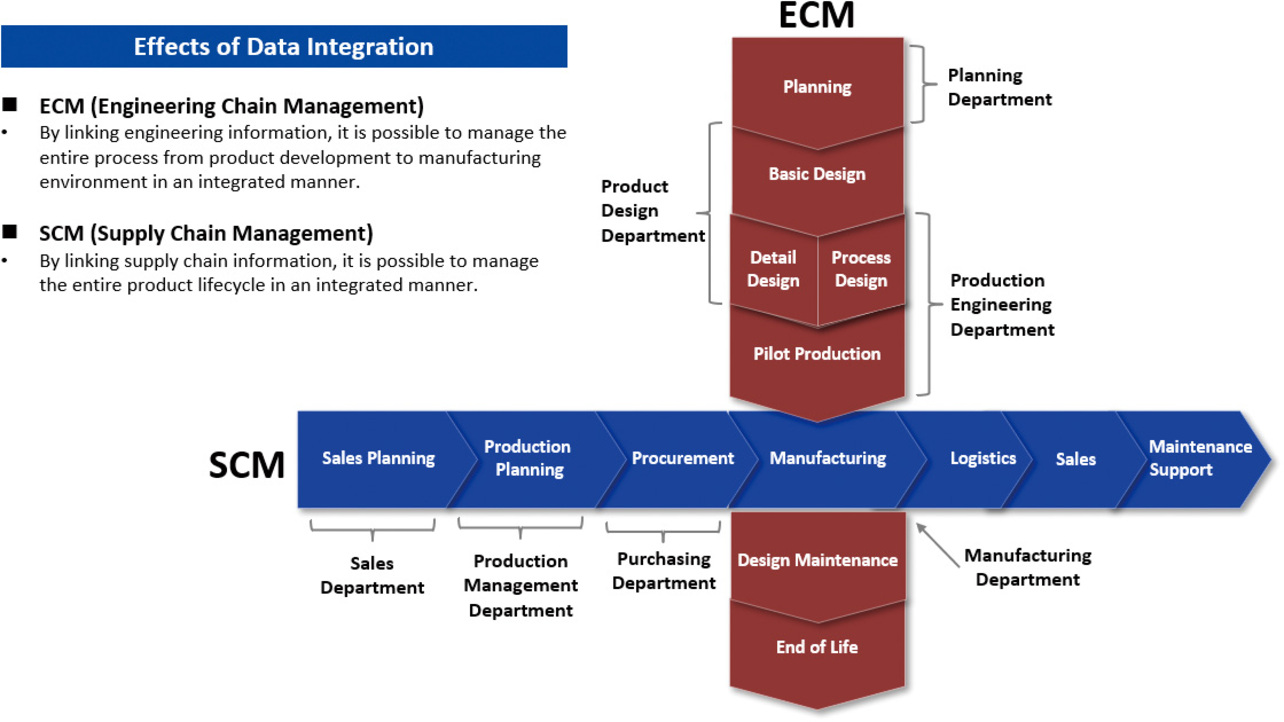
ECM is a structured approach that links product designs, equipment configurations, control programs, and other technical information across design, manufacturing, and operational processes. In this way, design changes and specification updates can be reflected on the shop floor in real time. The purpose of ECM is to enable integrated management of development and manufacturing.
On the other hand, SCM is used for cross-company sharing and the integration of logistics, quality, inventory, and environmental information from parts/components procurement through manufacturing, shipping, and maintenance to disposal. The purpose of SCM is to optimize the supply-demand balance and enable a sustainable supply framework.
This paper presents a summary overview of six representative use cases that leverage these chains side by side and are in high demand across global fields. More specifically, these use cases are as follows: product life-cycle traceability, environmental impact visualization, information disclosure to customers, smart maintenance, flexibilized production facilities, and automated shipping and inspection. These six use cases are designed to systematically cover the entire value chain of a manufacturer (design, manufacturing, shipping, maintenance, and disposal) and address the needs characteristic of Japanese manufacturing shop floors, such as high-mix, low-volume production, shop floor capabilities, and skill transfer.
This study organizes these six use cases below to leverage global standardization technologies and develop a data utilization platform that is flexibly adaptable to the characteristic strengths and challenges of Japanese manufacturing shop floors.
2.1 Product life-cycle traceability and quality assurance
Relevant chains: ECM and the whole SCM
In this use case, unique identifiers are assigned to products and parts/components to track and manage their history information across all processes from design through manufacturing, shipping, use, and maintenance to disposal. The aim is to enable traceability across the entire product life cycle. This arrangement convinces customers of the products’ reliability and safety, thereby enhancing the manufacturer’s brand value.
2.2 Visualization of environmental impacts and sustainability responsiveness
Relevant chain: SCM (from Manufacturing to Sales)
In this use case, CO2 emissions are calculated at the product, equipment, and part/component levels. The obtained data are shared across the entire supply chain to enhance cross-corporate responsiveness to environmental impact assessments and international regulations. The aim is to allow customers to select products based on highly transparent environmental information.
2.3 Product information disclosures to customers for enhanced trustworthiness
Relevant chain: SCM (Sales)
In this use case, an environment is developed in which customers can directly check the specifications, place-of-origin information, environmental impacts, and traceability information of products by scanning QR codes printed on the final products with smartphones or similar devices. The aim is to improve the brand’s transparency and trustworthiness and boost its environmental, social, and governance (ESG) responsiveness.
2.4 Smart maintenance for enhanced service quality
Relevant chains: ECM (Manufacturing to Design Maintenance)+
SCM (Manufacturing to Maintenance Support)
In this use case, on-site scannable identification codes are assigned to equipment and parts/components to enable immediate access to information, such as operation history, maintenance history, and wear condition. The aim is to reduce downtime, increase maintenance efficiency, and enhance equipment availability.
2.5 Flexibilized production facilities and customization responsiveness
Relevant chain: ECM (Planning to Design Maintenance)
In this use case, manufacturing equipment and parts/components are automatically identified, enabling optimal equipment settings to be applied based on a digital twin and enabling the simulation and optimization of process conditions in a virtual space. The resulting production environment can flexibly respond to diverse customer needs.
2.6 Automated shipping, inspection, and acceptance for enhanced reliability
Relevant chain: SCM (Procurement to Manufacturing)
In this use case, 2D codes assigned to delivered parts/components and shipped products are scanned and checked against manufacturing and quality data on a digital twin to automate acceptance, inspection, and authenticity checks. The aim is to improve customer delivery quality and response time, thereby enabling highly reliable transactions.
3. Approaches based on conventional technologies
Conventional FA systems have long been operated with business processes optimized for individual shop floors. The primary means of managing information has been paper- or Excel-based records. This practice has prevented engineering chain information, such as design changes and equipment configurations, from being reflected in real time on the shop floor. The practice has hindered the seamless coordinated procurement of parts and components and the sharing of quality information among companies in the supply chain.
The consequence has been a high likelihood of disconnected and personalized information. Disconnections between design and manufacturing, or between supply and maintenance, have posed obstacles to overall optimization and to the real-time data utilization required for the use cases.
These challenges are commonly seen across global manufacturing sites. Conventional technologies have failed to adequately address the needs characteristic of Japanese manufacturing shop floors, such as flexible adaptation to high-mix, low-volume production, knowledge sharing across organizations from shop-floor improvement activities, and streamlined skill transfer.
Intersystem interoperability must be ensured to achieve consistent data integration across all processes, from design through manufacturing and shipping to maintenance. Standardization technologies must be introduced to enable information integration and enhance operational efficiency.
4. PoC verification items towards use-case realization
Stakeholders and data-use purposes differ at each phase of the engineering and supply chains. Therefore, use-case realization is impossible without implementing standardized environments, contents, and interfaces.
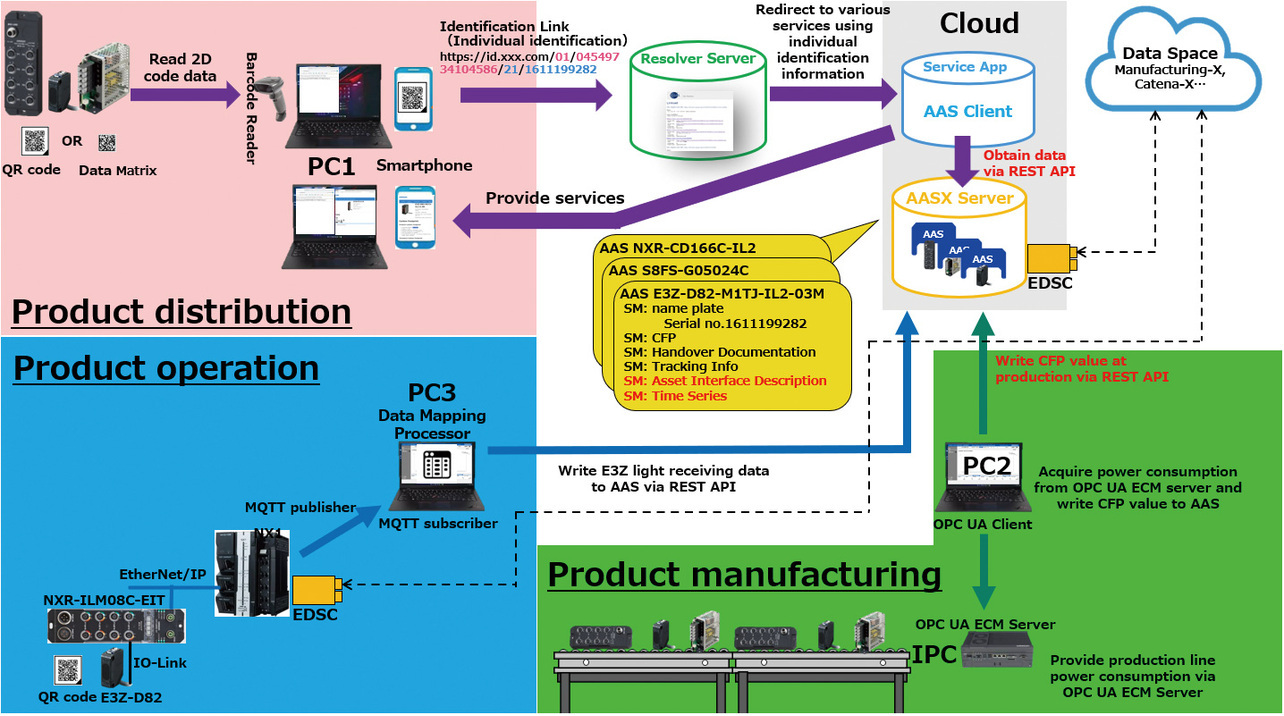
This section summarizes the PoC verification content for use-case realization with a focus on three functions: data recording, data sharing, and data utilization including dataspace. Fig. 2 provides an overall image of the PoC aimed at evaluating the effectiveness of standardization technologies, phase by phase, from product manufacturing through distribution to operation. Incidentally, dataspace is defined as an environment that enables secure, flexible data sharing and integration across multiple enterprises or systems without compromising data sovereignty.
4.1 Standardization technologies used in the PoC
For this PoC, standardization technologies currently deemed internationally promising were selected, implemented, and evaluated to shape the specifics of functional verification for data recording, sharing, and utilization. The outlines of the major standardization technologies employed are as follows:
- Asset Administration Shell (AAS)4-7)
The AAS is a digital twin technology at the core of Industry 4.0. The AAS is a framework for describing the attributes and functions of physical assets in standardized formats. This framework enables information exchange among different systems, thereby improving automation and interoperability across manufacturing companies. AAS serves as a platform for the centralized management of information on the product life cycle from design through manufacturing and maintenance to disposal. - OPC UA information model8,9)
An OPC UA information model is a meta-model that defines the semantics and structures of equipment or services, using address space nodes (Objects, Variables, Methods, DataTypes, etc.) and references connecting them. This information model consists of Type definitions (ObjectTypes and VariableTypes), and it features a generic, expandable design compliant with the modelling rules. - OPC UA for Energy Consumption Management (ECM)10)
OPC UA ECM is an information model that standardizes the collection and management of energy consumption data. The OPC UA communication platform is used to visualize and analyze equipment energy consumption in real time, enabling efficient energy management. The aim is to visualize environmental impacts and pursue energy-saving measures. - REST API
The REST API is a standard interface for web-based inter-system communication. This light, highly flexible interface allows concise retrieval, updating, and deletion of resources via the HTTP protocol. It is widely used for interfacing with IoT and cloud environments. Our PoC used the REST API to enable information integration with AAS and various databases. - Identification Link11)
The Identification Link consists of URI syntax and expressions for centrally managing product and asset identification information. Our PoC used GS1 Digital Link to make product information traceable throughout the entire product life cycle, facilitating enhanced quality control and traceability. - GS1 Digital Link12)
GS1 Digital Link is the standardized method for encoding product identifiers (e.g., GTINs) as URIs. This method provides access to product information, traceability, and warranty information via barcodes and RFID tags, thereby increasing transparency and efficiency in supply chains. Our PoC used GS1 Digital Link as a platform for QR code-based individual identification and information acquisition. - Eclipse Dataspace Components (EDSC)13)
EDCs are open-source components that enable secure and controlled cross-company data sharing. These components enable highly reliable data integration without compromising data sovereignty. Used mainly in Europe for data space development, EDCs are regarded as a promising emerging platform technology for cross-company coordination and ecosystem building. Incidentally, EDCs are one of the main implementations of the Dataspace Connector, which enables cross-company data sharing and access control.
4.2 Data recording
This PoC used the system configuration in Fig. 3 to verify a systematic method for recording product and equipment information at manufacturing sites. The information to be recorded was three-tiered: (1) type (form) information, (2) lot-level information, and (3) device-specific information (information tied to the serial number).
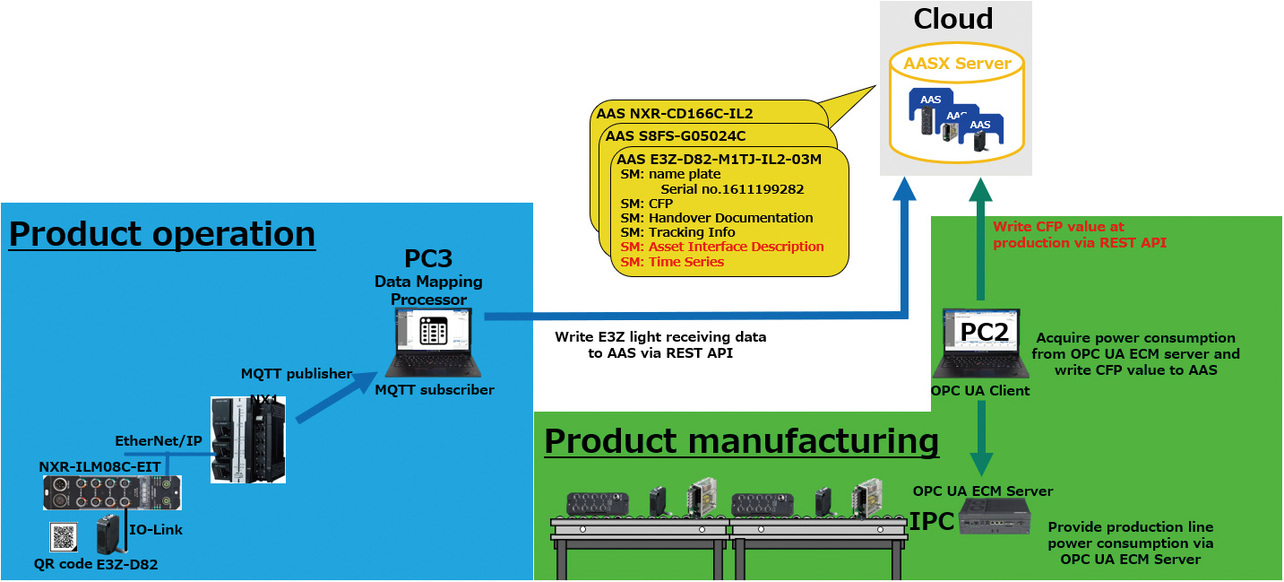
First, for each product and piece of equipment, an information model was built using the AAS. The AAS described the attribute, history, and environmental impact information in standardized data structures. Each information model was designed to be managed in accordance with the AAS standard specifications and to be uniquely accessible by type, lot, and serial number. The AAS metadata was assigned semantics information that specified data semantics, structures, units, and relationships to ensure consistent intelligibility and usability across shop-floor personnel, administrators, and machines.
The implementation procedure was as follows:
- Design and generate AAS information models.
- For each product/piece of equipment, an AAS information model is designed with the type-, lot-, and serial number-layer attributes defined.
- The AAS information is stored on a server with accessibility via standard interfaces.
- Generate and assign QR codes.
- For each product/piece of equipment, a QR code compliant with the Identification Link standards is generated and affixed.
- In each QR code, a URI for resolver access is embedded, enabling shop floor personnel and customers to obtain information via a smartphone or a dedicated terminal device. This paper defines a resolver as a function that takes URIs from QR codes as input and identifies correspondences between identifiers compliant with the Identification Link standards and information resources, thereby providing users with an appropriate method of information acquisition.
- Operate information records and updates.
- The AAS automatically records history information and environmental impact data generated during the manufacturing, inspection, and maintenance processes (see, for example, the timeline data during product operation in Fig. 3).
- Production equipment is defined by OPC UA information models widely used on the frontline, thereby seamlessly integrating equipment information with the AAS information (see, for example, OPC UA during product manufacturing in Fig. 3).
- The AAS information is updated at each design and process change in real time to ensure coherent information sharing across the shop floor, design, and management levels.
The results obtained verified that this arrangement was effective for departing from conventional paper- and Excel-based personalized record management and building a real-time, systematic information recording/management platform.
In addition, the QR code-based interface made information access easier for shop floor staff and customers, thereby improving traceability, quality assurance, and environmental responsiveness.
4.3 Data sharing
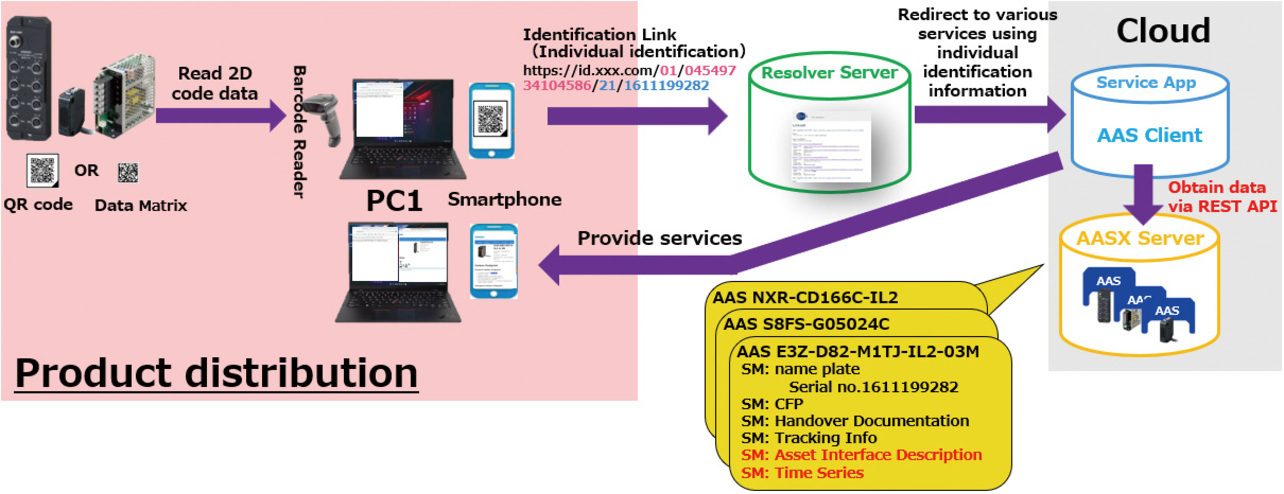
This PoC used the system configuration in Fig. 4 to verify a secure environment for easy sharing of product and equipment information among stakeholders. The information to be shared was that recorded in the AAS by type, lot, and serial number. The aim was to provide access to information at different organizational strata: shop floor staff to operational history, to design staff to manuals, to management executives to manufacturing sites, and to supply chain partners to lot information and CFP values as shown in Fig. 5.
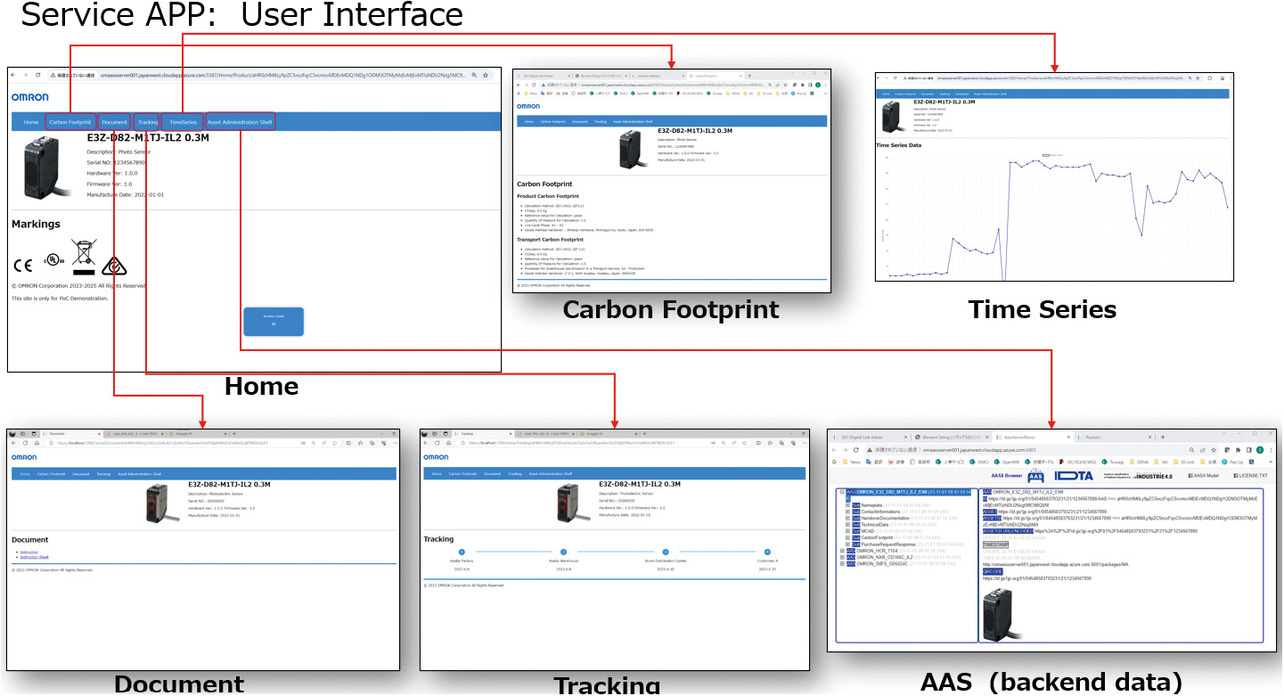
The following standardization technologies were used to implement information sharing:
- QR codes containing identification links
- For the implementation of identification links, the GS1 Digital Link technology was adopted for the built-in encoding of type, lot, and serial number information necessary for granularity-based access.
- QR codes (compliant with GS1 Digital Link standards) were affixed to the products/equipment to be scanned by shop floor personnel and customers with a smartphone or a dedicated terminal device for direct access to the AAS information.
- Differentiated service provision via the resolver
A resolver server was installed to interpret service information in user requests and redirect them to the relevant information. - REST API
- The REST API to the AAS information models stored on the server was provided to allow stakeholders to access information of required granularity (type, lot, or serial number level).
- The implementation was compliant with the REST API specifications, enabling information acquisition via GET operations.
The results obtained verified that this arrangement helped to depart from the conventional reliance on paper-based media and Excel spreadsheets, enabling real-time information sharing and automation.
4.4 Data utilization including a dataspace
This PoC used the system configuration in Fig. 6 to verify the possibility of integration with a dataspace.
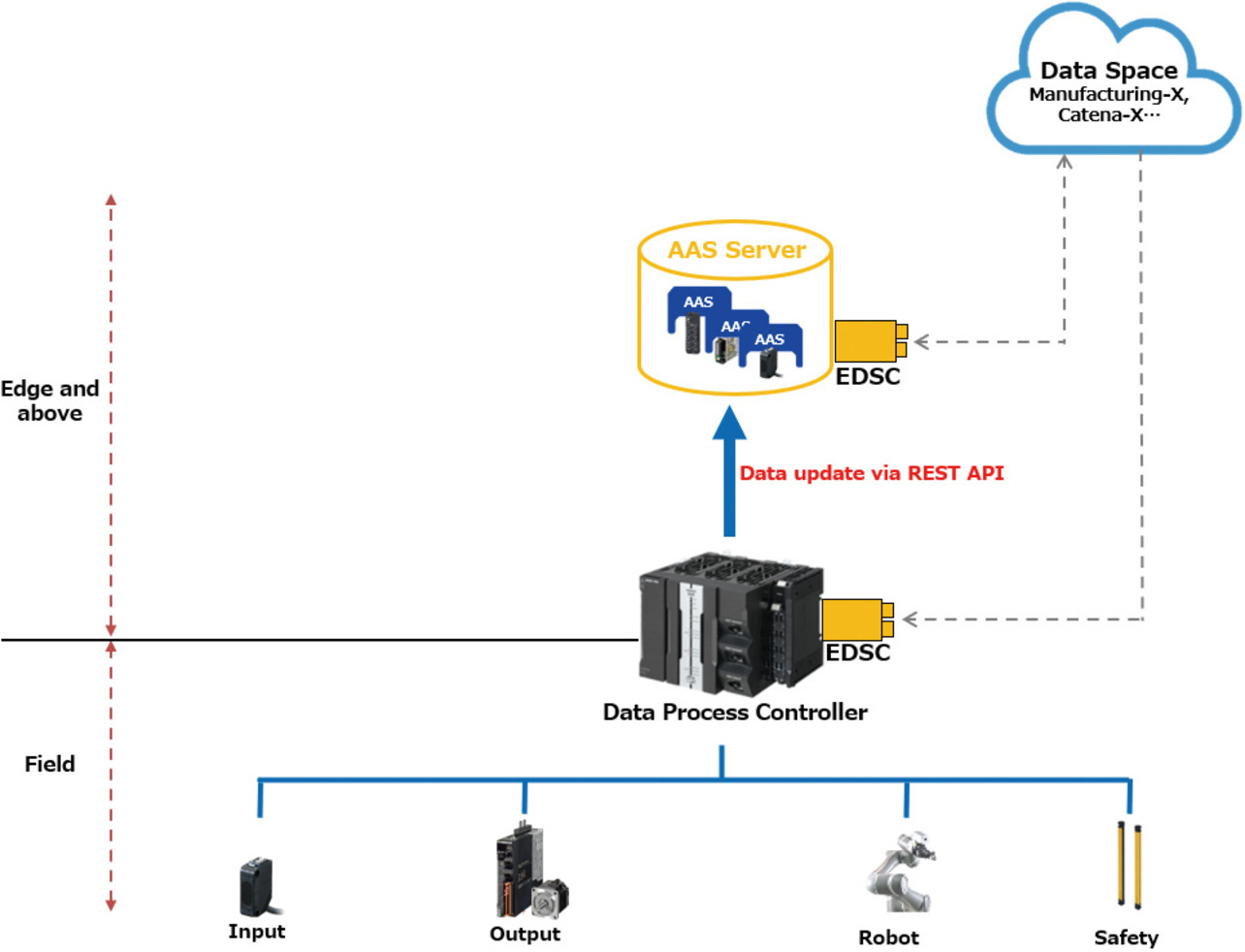
The following standardization technologies were used for integration with a dataspace:
- Dataspace Connector
The Dataspace Connector is software that enables secure, interoperable data sharing across companies and organizations. This tool is used to consult catalogs, hold contractual negotiations, and transfer data without compromising data sovereignty. - Eclipse Dataspace Components (EDSC)
- For data integration, EDCs were used with access rights and security requirements specified for individual users.
- The data on all the EDC-based AAS servers were made available.
- Information required for PLC control was obtained via a dataspace.
The results obtained verified the effectiveness of this arrangement in data sovereignty assurance, access right management, automated contracting, and security delivery.
5. Use-case achievements and the remaining challenges
5.1 Use-case achievements determined by the PoC
The following are the use-case achievements obtained as a result of the PoC presented in Section 4:
- Product life-cycle traceability and quality assurance
AAS and GS1 codes were used for central management of product information across all phases, from design through manufacturing, shipping, and maintenance to disposal. QR code-based individual identification and immediate access enabled on-the-spot history checks/recall handling and streamlined quality audits. - Visualization of environmental impacts and sustainability responsiveness
Carbon footprints (CFP) per product were recorded in the AAS to visualize environmental impacts through OPC UA ECM and the REST API. An environment was developed to enable shop floor staff and customers to access CFP information via QR codes. - Product information disclosures to customers for enhanced trustworthiness
QR codes were used to allow the customers to obtain product specifications, place-of-origin information, CFPs, and history information stored in the AAS. The results obtained verified improvements in transparency and trustworthiness. - Smart maintenance for enhanced service quality
Scannable QR codes were affixed to the equipment and parts/components, enabling immediate access to maintenance history and operation information stored in the AAS. The results obtained verified that this use case helped to reduce the time worked and mistakes. - Flexibilized production facilities and customization responsiveness
Machines were affixed with scannable QR codes to obtain machine information from the AAS. The results obtained suggested the possibility of addressing process changes with improved preparatory work efficiency or flexible production. - Automated shipping, inspection, and acceptance for enhanced reliability
QR codes on products were checked against manufacturing and quality data in the AAS. The results obtained verified that this use case could automate inspection processes, prevent delivery errors/forgeries, and reduce shipping errors.
The results of this PoC show that AAS, Identification Link, and other standardization technologies enable traceability across the entire product life cycle, environmental impact visualization, advanced customer information services, and more, thereby enabling a departure from conventional, personalized/disconnected business processes. These results provide a vision for an enhanced data utilization platform integrated across the shop floor, design, and management levels.
5.2 Remaining challenges
On the other hand, full-scale cross-company or cross-factory data sharing, Dataspace Connector-based external connections, user access right management, overall ecosystem security design, and other use cases are still in a limited verification phase.
The results obtained verified that the six use cases were compatible with data sharing, provided human operators select the data. However, service codes lack the semantics strong enough for machines to specify data automatically. The term service code refers to a code and an identifier that specifies the type and content of data required by a machine or system. Proper service codes would automate data retrieval and sharing to suit the intended purpose without human intervention. Therefore, service codes must be further standardized to meet the needs of all stakeholders, including machines.
6. Conclusions
This paper explored the possibility of FA systems evolving from control-centric to information-driven systems, and the feasibility of developing a data platform using standardization technologies. It presented a vision for a data utilization platform integrated across the shop floor, design, and management levels through standardization technologies, such as AAS, OPC UA, Identification Link, REST API, and Dataspace Connector. The verification results show that such a platform enables multifaceted value creation, including traceability across the entire product life cycle, visualization of environmental impact, and advanced customer information services.
The path ahead requires further technological development and demonstrations. Examples include enhanced automated generation and updating of AAS, demonstration of Dataspace Connector-based cross-company coordination, advanced customer information services integrated with digital product passports (DPPs), and process optimization through integration with AI and data analysis technologies. Standardized service codes required to enable automated machine access are a particularly critical challenge common to all global manufacturing sites. This challenge deserves accelerated international standardization activities.
I share the study’s outcomes with readers in the hope of jointly exploring the frontier of next-generation manufacturing to overcome challenges and realize future visions.
References
- 1)
- Object Management Group. The Data Centric Architecture of a Factory Digital Twin, 26th ed. (2025). Accessed: Dec. 25, 2025. [Online]. Available: https://www.objectmanagementgroup.org/wp-content/uploads/sites/8/2025/02/JOI_20250204_6_The_Data_Centric_Architecture_of_a_Factory_Digital_Twin_Standalone.pdf
- 2)
- European Parliamentary Research Service. “Standards and the Digitalisation of EU Industry: Economic Implications and Policy Developments.” European Parliament. https://www.europarl.europa.eu/RegData/etudes/BRIE/2019/635608/EPRS_BRI%282019%29635608_EN.pdf (Accessed: Dec. 25, 2025).
- 3)
- Deloitte. “2025 Smart Manufacturing and Operations Survey: Navigating Challenges to Implementation.” Deloitte Insights. https://www.deloitte.com/us/en/insights/industry/manufacturingindustrial-products/2025-smart-manufacturing-survey.html (Accessed: Dec. 25, 2025).
- 4)
- Specification of the Asset Administration Shell Part 1: Metamodel, IDTA Number: 01001, 2025.
- 5)
- Specification of the Asset Administration Shell Part 2: Application Programming Interfaces, IDTA Number: 01002, 2025.
- 6)
- Specification of the Asset Administration Shell Part 3a: Data Specification – IEC 61360, IDTA Number: 01003-a, 2025.
- 7)
- Specification of the Asset Administration Shell Part 5: Package File Format (AASX), IDTA Number: 01005, 2025.
- 8)
- UA Part 3: Address Space Model, OPC 10000-3, 2025.
- 9)
- UA Part 5: Information Model, OPC 10000-5, 2025.
- 10)
- Energy Consumption Management, OPC 34100, 2025.
- 11)
- Identification Link – Part 1: General Requirements, IEC 61406-1:2022, 2022.
- 12)
- GS1. “GS1 Digital Link.” GS1. https://www.gs1.org/standards/gs1-digital-link (Accessed: Dec. 25, 2025).
- 13)
- Github, inc. “EDC Connector.” Github. https://github.com/eclipseedc/Connector (Accessed: Dec. 25, 2025).
The names of products in the text may be trademarks of each company.
Microsoft and Excel are either registered trademarks or trademarks of Microsoft Corporation in the United States and other countries.