








OMRON's Technological Advancements in DX Leading Towards the Digital Society
Today, the use of digital technologies is rapidly spreading across various areas of society, with examples such as data analysis, machine learning, artificial intelligence (AI), and simulations. This trend has been accelerated by over half a century of societal automation and the widespread adoption of digital technologies in today’s information-oriented society. The term digital transformation (DX) refers to the transformation of society achieved through digital technologies, resulting in improved societal productivity, reliability, safety, and convenience. It is anticipated that the development of new technologies that support DX and their further application in society will continue to accelerate.1) This issue outlines OMRON's initiatives in DX, particularly within manufacturing processes, and discusses the direction of our future technological development and the progress expected over the medium to long term.
DX in manufacturing
At OMRON, we are currently working to improve the productivity of our manufacturing processes. Specifically, we are aggressively incorporating digital technologies into product design and product lines to transform our engineering processes. The engineering processes such as designing power sources for factory automation and power conditioners for household photovoltaic power generation systems, require repetitive verifications using prototypes to ensure the performance and quality of the final product. As a result, the process demands significant time and labor and increases the development time. To ease this time and labor consuming process, we use simulation tools such as computer-aided engineering (CAE) along with the digitized design information and verify performance and quality through simulations. Incorporating these development methods into manufacturing processes enables us to reduce the cost of prototype production and verification, while also reducing the development lead time.
The potential of development methods that use simulation goes beyond just the reduction of development lead time. By simulating and adjusting various combinations of design parameters to optimize them, we can reduce product size and enhance performance. These achievements were not possible through conventional verification using prototypes because of cost constraints and limitations in the development time. We are currently developing technologies for this kind of design optimization in collaboration with external research institutions.
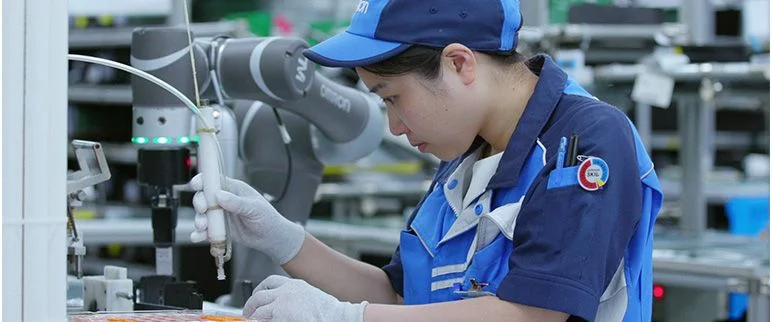
We are also expanding the use of digital technologies in our production lines. Production lines require equipment adjustments when changes occur, such as switching the products being manufactured or when equipment malfunctions occur. In many cases, these adjustments require complicated operations, requiring the knowledge and skills of experienced engineers. Also, production lines must be stopped during adjustments, which reduces productivity. To reduce these setbacks, we are developing methods to utilize digital technologies for equipment adjustments. We use simulations to verify the operation of entire production lines after adjustments are made. Data analysis, machine learning, and AI help to identify equipment conditions and assist operators with the adjustment tasks.
In this issue, we introduce OMRON's initiatives to utilize digital technologies to improve the productivity of our manufacturing processes.
Human-machine interaction
AI technologies have been advancing at a remarkable pace in recent years. With generative AI, including large language models (LLMs), AI can now engage in conversations with humans as naturally as if they were speaking with a real person. Generative AI can absorb the natural variations in humans’ linguistic expressions and provide supplementary information for humans’ abstract expressions, thereby interpreting humans’ intentions. Using this ability of generative AI to interpret the intentions of a human and convert them into a format that the machine understands, we will be able to issue commands to machines using natural language. With this technology, we will be able to issue commands using simple language to machines that have traditionally required complicated operations. Furthermore, AI Agent,2) an advanced version of generative AI capable of voluntarily interacting with both people and machines, will be able to offer guidance on machine operations to support adjustments that only skilled engineers could previously understand. We also expect that the AI agent will eventually be able to operate machines independently.
At OMRON, we will continue developing technologies that leverage generative AI with a focus on a future where people can interact with machines in this manner.
Towards an autonomous society with human-machine cooperation and co-creation
Once interaction between people and machines using natural language is realized through digital technologies, people will no longer need to handle complicated operations. When digital technology reaches this level, it will bring us closer to a concept of “human-machine cooperation and co-creation” with machines operating seamlessly alongside humans. The concept of “human-machine cooperation and co-creation” can be applied effectively across all areas of society, not just in manufacturing processes.
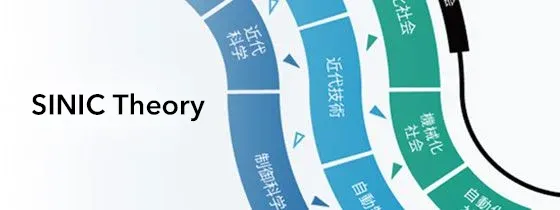
Based on the SINIC theory,3) our society has progressed through several stages: an automated society where machines take on tasks done by the people to free them from the burden; an information society where the various machines are connected by data using information and communication technologies; and an optimization society where values shift from material wealth to spiritual wealth. And we are now moving toward an autonomous society. In such a society, individuals will be able to live and work autonomously utilizing cooperation between people and machines, not merely pursuing efficiency and productivity. In that sense, digital technologies will become increasingly important to us, and at OMRON, we are committed to taking on challenges in pursuing these possibilities.
- 1)
- Ministry of Economy, Trade and Industry. “Digital Governance Code 3.0 - Toward Enhancing Corporate Value through DX Management. ” Ministry of Economy, Trade and Industry. https://www.meti.go.jp/policy/it_policy/investment/dgc/dgc3.0.pdf (Accessed: Mar. 14, 2025).
- 2)
- Y. Shavit et.al., “Practices for Governing Agentic AI Systems.” OpenAI. https://cdn.openai.com/papers/practices-forgoverning-agentic-ai-systems.pdf(Accessed: Mar. 14, 2025).
- 3)
- Shinichi Nakama, SINIC Theory, JMA Management Center, 2022.
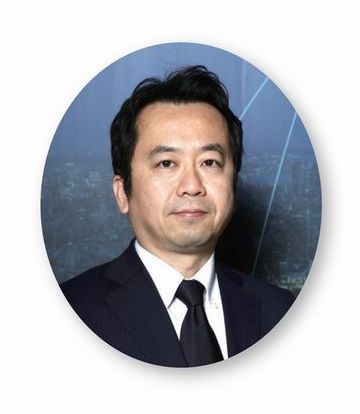
Matsubara Daisuke Manager, Strategy Division, Technology and Intellectual Property H.Q, OMRON Corporation