- Follow us


The Longine IR Department interviewed Yoshihito Yamada, President and CEO at OMRON Corporation (securities cord: 6645; hereafter "OMRON") about the company's new management system and control equipment business as well as growth strategies.
Three key points presented by the Longine IR Department to investors
- Threefold Management comprising CEO, CFO and CTO speedily responding to diversified customer demands and business environment changes.
- The best matching of people and machinery now happening at manufacturing gemba, which is one of the changes leading to growth opportunities in the company's control equipment business.
- OMRON steadily executing basic strategies for continuous growth.
Longine IR Department (hereafter Longine):
You assumed the presidency shortly after the Great East Japan Earthquake, an extremely difficult time to be at the helm of management as the new president. Please describe your involvement in management before taking office as the president.
Yoshihito Yamada, President and CEO, OMRON Corporation (hereafter Yamada):
A year before assuming the presidency, I had been appointed the Group Strategy General Manager, a position to unify all OMRON companies in 2010 after resigning as chief officer of the health care business. My main mission then was the development of long-term visions called VG 2020, which would encompass the next 10 years. In June 2011, I took over management as the group's CEO, a position to practice the ten-year visions I myself developed.
Longine:
What was your emphasis when devising the long-term VG 2020 visions?
Yamada:
The biggest issue OMRON faced at the time of VG 2020 development was how to recover its "power to grow". The decade for GD 2010, the previous 10-year visions, our management was confronted with adverse conditions due to the Lehman shock, IT bubble collapse and rapid progress of a strong yen. Even though we were able to achieve some sales growth under such circumstances, I have to say that a 4% sales growth rate for the decade was too low.
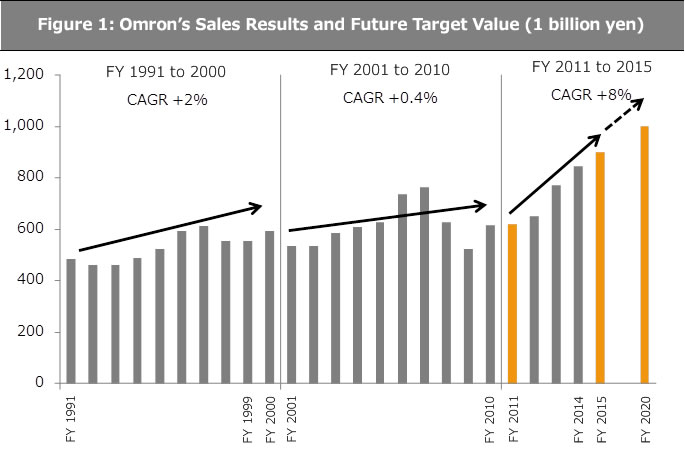
Source: Prepared by the Longine IR Department, based on SPEEDA and data provided by the company
Longine:
According to Figure 1, the yearly average growth rate (CAGR) of sales from FY 1991 to FY 2000 marks +2%, while that from FY 2001 to FY 2010 is +0.4%, both of which cannot be considered high. However, the yearly average growth rate from FY 2011 to FY 2015 (including company forecast) has improved to +8%. The power of growth has obviously been restored as far as we can see from the figures. Are there any factors you emphasized in VG 2020 other than sales growth?
Yamada:
The other focus was to regain the "power to earn". We are striving to increase profitability at the same time as enhancing sales by using the gross margin rate as an evaluation index.
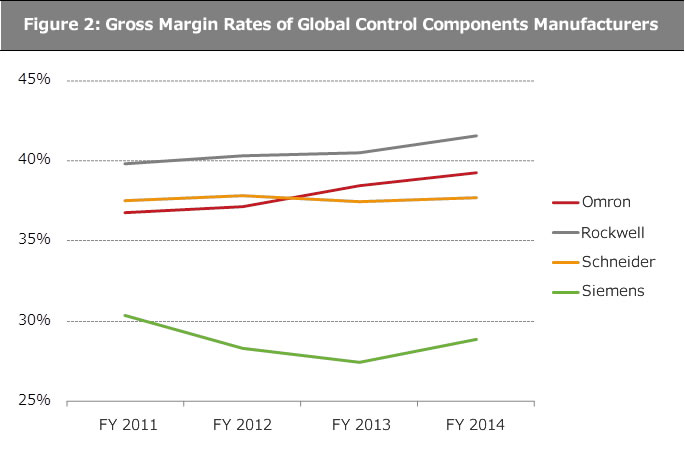
Source: Prepared by the Longine IR Department, based on SPEEDA and data provided by the company
Note: The fiscal year-ends for Rockwell and Siemens: September; and for Schneider, December.
Longine:
Figure 2 shows gross margin rates during FY 2011 to FY 2014 of leading control equipment manufacturers in the world. OMRON's line shows a rise, along with sales, just as seen in Figure 1. In addition, its gross margin rate in FY 2014 is 39%, already rivaling profits of global control equipment businesses including Rockwell (U.S.) and Schneider (France). Is it possible for OMRON to maintain profitability in the future?
Yamada:
Yes, I think we can do it, still much more. We rank the gross margin rate as one of the most important management indexes and by using it, we are striving to improve the continuous "power to earn".
Ideal roles of Threefold Management with CEO, CFO and CTO, all with actual business manager experience
Longine:
You have installed and appointed people to new positions; CFO (Chief Financial Officer) since two years ago and CTO (Chief Technology Officer) starting this year to change the management system. Please explain the aim of this decision.
Yamada:
Because CFO and CTO are indispensable to develop/implement group-wide strategies. OMRON is a collective of business companies. After completing stages to strengthen individual business functions, it has entered a new stage for total optimization, while fully exploiting each entity's individual strength. Accelerating the deployment of M&A and group-wide technological strategies can be a good example of total optimization management.
Longine:
What kind of new proposals can developing group-wide technological strategies bring?
Yamada:
I will show you an automotive component example. In self-driving cars, the function to constantly monitor the state of the driver can be a big development project. Sometimes, proposals utilizing living body information sensing technologies developed in our health care business may be requested by our car manufacturer customers. In addition to that, proposals that are different from those from other specialized automotive components makers are also expected of OMRON, a company comprising various business fields including the social system business based on road transportation project experience and factory automation, in addition to health care business. To meet such customer expectations, it is necessary for each business department to collaborate.
Longine:
The hurdle will be high and there will be risks involved, when preparing a large number of unprecedented sharp proposals spanning across departmental and industrial borders. Who will serve as the control tower in this operation?
Yamada:
The CEO, namely, I myself used to. But there was a limit to one person's effort. Therefore, I have appointed Yoshinobu Suzuki (current vice-president), who had been the chief officer of the automotive department to CFO as my management partner. We have formed an assessment team to think about the company's total optimization, resource allocation, on which I base my decision making. This April, I also appointed Kiichiro Miyata, the former chief officer of the health care business, to CTO and transferred him part of my authority to accelerate implementing group-wide technological strategies.
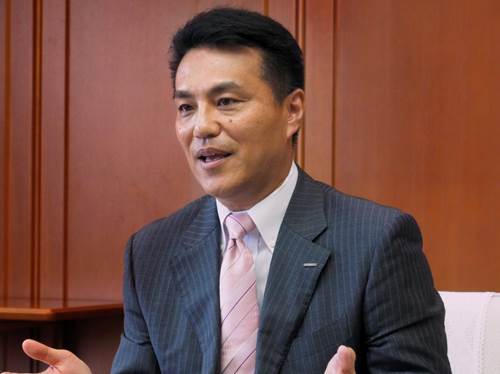
Yoshihito Yamada, President and CEO, OMRON Corporation
Longine:
What roles do you expect of CFO, the position deemed as your partner?
Yamada:
One of his roles is business portfolio management. The initiative to solve issues in society through business and using the OMRON Principles as a unifying force has deeply spread throughout the group. For example, our world-first innovation of the automatic ticket gate and CD (cash dispenser)/ATM was all based on this very idea. With this idea as the basis, OMRON's employees naturally want to engage in various challenges. However, trying to do all this will disperse resources and I'm afraid more than anything else that this may lead to defeats in strategic local battles. As the CEO, I must see to it that the entire resource is distributed appropriately. Therefore, I ask the CFO to make judgments and assessments based on numeric data while considering economic rationality. I often base my decisions for investment and withdrawal on his assessment results.
Longine:
Judgment to withdraw is one of the most challenging tasks for any business owner, isn't it? What criteria would you use for that kind of judgement?
Yamada:
Our management is based on ROIC. In other words, it measures how much return is achieved against investment. OMRON has six business segments, which are subdivided into 100 business units. By mapping all these units in a four quadrant matrix comprising the two axes of ROIC (return on investment) and sales growth rate, we can evaluate individual business values and assess our decision for withdrawal.
Longine:
Could you detail merits gained when CTO and CFO functions work well in a technology-oriented company?
Yamada:
Customer demands have diversified. Many of them are related to more than one business segment or require crossover among different technologies. Since changes suddenly come and quickly go, you must swiftly distinguish between businesses with high and low potential. Both CFO and CTO functions play an indispensable role to filter financial and technological feasibility whenever necessary, while encouraging various challenges. I will intensify my effort to achieve constant growth through the trinity of CEO, CFO and CTO in the future.
Longine:
The control equipment business forms a major part of OMRON's profit structure. Please tell me concrete activities of your control equipment business.
Yamada:
The control equipment business can be briefly summarized as the "manufacturing business for manufacturing businesses". Manufacturing processes may change with the passage of time, but manufacturing itself will never disappear from this world. Needs for advanced functions in various products including cars and smart phones rapidly change the engineering methods and production lines. While managing these changes, we strive to contribute to further development of manufacturing by providing optimal applications and products.
Longine:
How do you predict changes in manufacturing in the future?
Yamada:
Manufacturing processes such as assembly and inspection, which were manually performed by humans, are increasingly being automated even in the emerging markets. If not fully automated, they will be semi-automated by combining partial involvement of both machines and human operators. The best matching of people and machinery is happening now. Such a domain is OMRON's greatest forte and the top priority of our growth should happen from here.
Longine:
You uphold the goal "more than 10% increase in consolidated operating income ratio" in FY 2016, and 15% in VG 2020. The growth of the control equipment business, which has the highest profit ratio, is paramount to the achievement of VG 2020 goals. Please explain your future growth strategies.
Yamada:
The operating income ratio of the control equipment business has already exceeded 15%. Keys to achieve VG 2020 goals include even increasing the profitability of the control equipment business and accelerating its business growth to enhance its ratio in the group-wide sales amount constitution. Furthermore, we actively promote M&A and alliance projects to ensure growth.
OMRON's growth strategies
Longine:
You have included three basic growth strategies in VG 2020. Are your M&A activities based on them?
Yamada:
Exactly. The first of three basic strategies is intensively reinforcing the IA (Industrial Automation) business centered on the control equipment business. One of the strengths of our control equipment business lies in wide-ranging products, but I think we should keep strengthening this aspect by exploiting powerful M&A activities. The second policy is developing emerging markets. Efforts in this area include purchasing local sale channels, or local brands or manufacturers with sales channels to distribute our wide product lineups to global customers. The third is reinforcing new business, particularly, environment-related ones, aiming for further growth through M&A.
Longine:
You completed the second M&A last year to expand sales in an emerging market. Could you detail the project?
Yamada:
We purchased a Brazilian nebulizer manufacturing and sales company (NS) for our health care business in October, 2014. With this purchase OMRON has captured the No. 1 share in the global nebulizer market. In addition, by exploiting NS channels, we could penetrate the health care market in South America, which otherwise would have remained unexplored. We have also become the top blood pressure monitor supplier in Brazil.
Longine:
You said your focus includes environment-related new businesses. What kind of business do you actually have in mind?
Yamada:
Our main focus lies in energy management. Our ideas are based on optimization using sensing & control technologies. The power conditioner for solar power generation is an example.
Longine:
Liberalization of the electricity market will seemingly bring energy-related changes in the future. How do you plan to steer your business under such circumstances?
Yamada:
Power supply decentralization and mini-grid supply will make progress. Optimal management within small scales presents us big business opportunities. It requires minute precision in energy consumption sensing as well as control technology to supply an appropriate amount of electricity. Conventional models of generating large quantities of electricity at large-scale power stations for distribution will shift to optimization at smaller scales. Under such an environment, more batteries and power conditioners will be required, alongside a great number of sensors to detect the state of batteries.
Longine:
I gained a thorough understanding about the three basic strategies and M&A policies based on them. Thank you very much for your time today.
Yamada:
The pleasure is mine. We at OMRON constantly uphold our long-term visions, and strive to become "a company whose presence is needed and whose service is expected by global people". I would like to ask for your continuous support.

© Copyright OMRON Corporation 2007 - All Rights Reserved.