OMRON

Global

  1. Home
  2. About OMRON
  3. CSR (Corporate Social Responsibility)
  4. Environment
  5. Eco-Factories / Laboratories / Offices
  6. CO2 Emissions Reduction

CO2 Emissions Reduction

  • Text Size
  • Small
  • Medium
  • Large

Targets

Self-assessment rating ○:Targets achieved ×:Targets not achieved

Targets Improve carbon productivity (global sales / CO2 emissions from global production sites) by 30% from the FY2010 level by FY2020
Progress in FY2011 Achieved a 3% improvement in carbon productivity (FY2011 global sales / CO2 emissions from global production sites) from the FY2010 level. Progressed smoothly

Basic Policies

OMRON believes that promotion of anti-climate change measures is an important social responsibility that the company must fulfill, both now and into the future. Accordingly, OMRON established its new environmental management vision entitled “Green OMRON 2020” in fiscal 2011. With this vision, OMRON set forth a new goal for fiscal 2020 in terms of carbon productivity,* and has been working to improve carbon productivity by 30% compared to the fiscal 2010 level.

To achieve this goal, the OMRON Group as a whole will work to promote more efficient operation of its facilities and equipment through manufacturing aimed at energy and resource conservation (Eco-Monozukuri).

Specific measures being taken to meet this goal include installation of energy monitoring systems to visualize energy usage at each facility and for production, in order to evaluate the effectiveness of energy conservation efforts. Based on the results of these evaluations, OMRON will make investments in equipment to ensure optimal energy supply for each equipment piece and production line. OMRON will also apply its accumulated expertise to similar equipment and lines, aiming to eventually meet its CO2 emissions reduction goal.

To fulfill its responsibility as a manufacturer, OMRON will also specify targets for the degree of contribution to CO2 emissions reduction in society through its products and services.

* Carbon productivity (millions of yen / t-CO2) = Sales of global production sites (millions of yen) / CO2 emissions from energy usage by global production sites (t-CO2)

FY2011 Overview

In fiscal 2011, the OMRON Group’s carbon productivity was 3.33, while CO2 emissions amounted to 186,110 metric tons at the global level, representing a 3% improvement in carbon productivity from the fiscal 2010 level.

【Japan】
The suspended operation of nuclear power plants, stemming from the March 2011 earthquake and tsunamis, caused electricity shortages throughout Japan. This resulted in requests from the government and electrical power companies to cut electricity consumption in the summer and winter.

In response to this national-level issue, OMRON established in-house targets that are more demanding than the requests from the government and electrical power companies. By implementing the following electricity conservation measures throughout the OMRON Group in Japan during summer and winter of fiscal 2011, OMRON was able to significantly surpass electricity conservation targets without compromising its business and production activities.

  1. Installed energy monitoring systems in 21 OMRON Group sites for realtime visualization of power usage, enabling demand control for the service district of each electric power company.
  2. Promoted improvement of facilities/equipment operations through manufacturing aimed at minimizing energy/resource usage (Eco-Monozukuri).
  3. Implemented strict power-saving efforts among employees through the “Super Cool Biz” initiative and other measures with the slogan “Be patient, save, and streamline.” Also encouraged efforts to conserve electricity at home.

Going forward, OMRON will aim to further reduce CO2 emissions by continually promoting on-going energy conservation initiatives, while also adopting equipment control suitable for the conditions of production sites, as well as encouraging employees to wear “Super Cool Biz” outfits in offices.

Also in fiscal 2012, as reduction of electricity consumption will continue to be required according to the government’s requests, OMRON will set forth in-house targets even stricter than the government’s requests, as in the previous fiscal year.

【Overseas】
In fiscal 2011, OMRON promoted manufacturing operations in Greater China aimed at minimizing energy and resource usage (Eco-Monozukuri) in major production sites, which are heavy users of energy. This became the main contributor to reduction of CO2 emissions.

In fiscal 2012, OMRON will continue to promote Eco-Monozukuri operations at production sites in Greater China.

DATA CO2 Emissions (Japan and Overseas)

DATA Energy Usage (Japan and Overseas)

Manufacturing Operations Aimed at Minimizing Energy/Resource Usage (Eco-Monozukuri) at OMRON Sites

Managing Energy Usage on a display

EManaging Energy Usage on a displayManaging Energy Usage
on a display

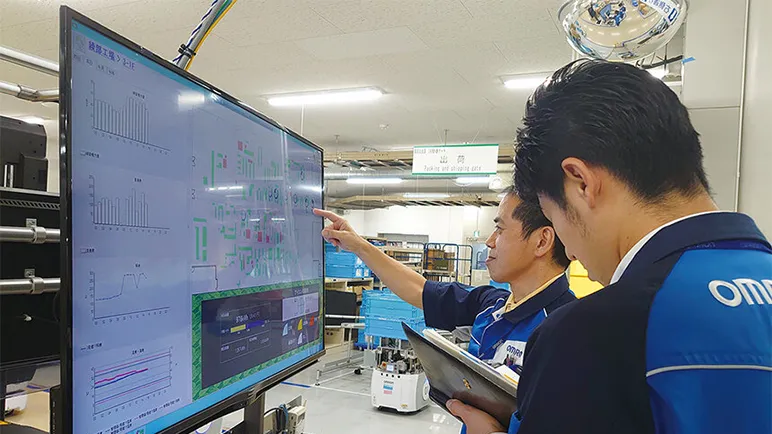
In June 2011, OMRON’s “M2M e-watching” system was deployed at 21 OMRON sites to enable visualization and monitoring of combined power usage for each area. By building a system to control demand through the collaboration of sites within each electric power company’s service district, OMRON was able to meet its electricity usage reduction targets without interfering with its business and production activities. As a result, reductions of 31% and 22% were achieved in the service districts of Tokyo and Kansai Electric Power Companies, respectively, against the 15% reduction target. Moreover, reductions of 14%, 12%, and 16% were attained in the service districts of Chubu, Chugoku, and Kyushu Electric Power Companies, respectively, against the in-house reduction target of 10%. In all, the OMRON Group was able to far exceed its power usage reduction targets in all districts.

In fiscal 2011, thanks to the implementation of manufacturing operations aimed at minimizing energy and resource usage (Eco-Monozukuri) for the OMRON Group as a whole during the summer of 2011, the Group was also able to cut electricity consumption during the winter. OMRON is also expecting significant results in the summer of fiscal 2012 as well.

Manufacturing Operations Aimed at Minimizing Energy/Resource Usage (Eco-Monozukuri) in China

underwent energy conservation diagnoses in China

underwent energy conservation diagnoses in ChinaUnderwent energy conservation
diagnoses in China

To promote energy-saving activities in a continuous and systematic manner, OMRON has been implementing an initiative intended to measure the total amount of energy usage at each factory building and by each machine. Through analysis of this data, OMRON aims to detect inefficiencies, losses, and unevenness in energy usage, in order to improve equipment/machine operations.

This initiative had been put into practice at all production sites in Japan by fiscal 2010. In fiscal 2011, adoption of the same initiative was initiated outside Japan, with operation improvements carried out at three model sites in China that are heavy users of energy.

By setting up energy monitoring systems in these sites, points requiring improvement were discovered, mainly for air conditioners and compressors, both of which consume large amounts of energy. Based on the analysis of measured data, improvement measures were devised and tested.

Operation improvements include equipping fans with an inverter to reduce air flow, adjusting the frequencies of fans and pumps, fixing air leaks from compressors, and controlling the number of compressors in use. Through these improvements of equipment operations, a CO2 emissions reduction of 8% was achieved compared to the previous year. In fiscal 2012, OMRON aims to document this acquired know-how in a manual so that it can be adopted for other sites in China, while also working on operation improvements for production equipment.

Reduction of GHGs Use and Emissions

OMRON employs greenhouse gases for manufacturing semiconductors and cleaning electronic components. As such, efforts are concentrated on reducing usage and emissions of GHGs at each site. OMRON Relay & Devices Corporation’s Iida Factory succeeded in cutting usage of HFCs by revising the production process.

DATA Non-CO2 Greenhouse Gas Usage/Emissions (Japan)

Top of Page